

A Simple Block Building Activity for Kids: Turning Squares into Flowers (the Fröbel Way)
Give a child a handful of cubes and she’ll build the world of made things — a tower, a wall, a house, a road. Straight edges, right angles, flat faces stacked square on square. It’s the world of the built, and blocks are perfect for it, because the built world is mostly straight lines.
Then ask her to build a flower.
Watch the hesitation. A flower isn’t made of right angles. Nothing alive is. Leaves curve, petals round, stems bend — the living world runs on curves, and a box of square blocks seems, suddenly, like the wrong tool entirely. But hand her a few curved pieces to set among the cubes — rounded columns, semicircles, anything with a curve to it — and something quietly wonderful happens. She sets four cubes into a little square core, adds curved pieces around the edges, and all at once it isn’t a square anymore. It’s a cloverleaf. It’s alive.
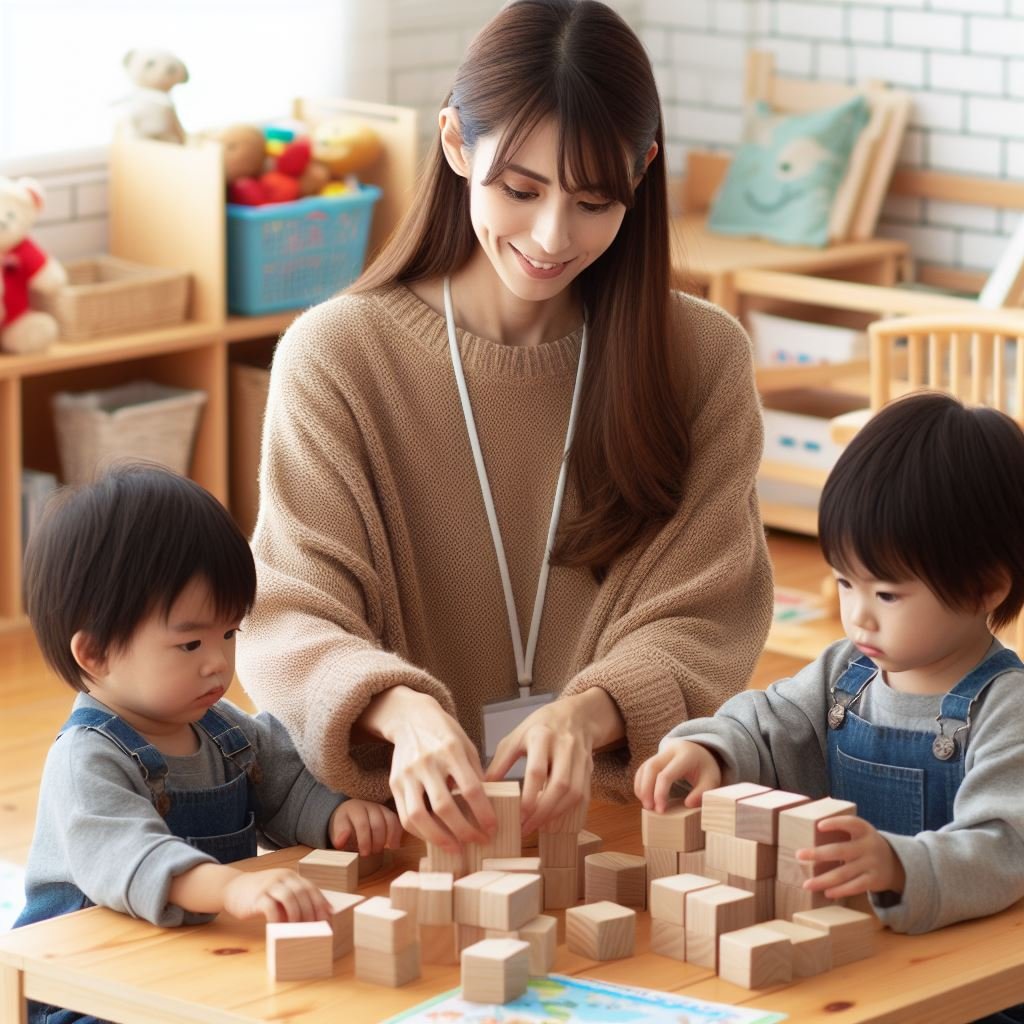
Picture a moment like this one: a child who’s been stacking blocks into buildings all morning arranges cubes and curves into a rough four-petalled clover, sits back, and says “it’s a flower now” — with a small note of surprise, as if the hard blocks had done something they weren’t supposed to be able to do.
That moment — the square becoming a flower — is a child crossing the oldest divide in Fröbel’s whole philosophy, and he built his entire sequence of Gifts around it.
Here’s the idea. Fröbel’s very first two Gifts are the sphere and the cube — the round and the straight — and he chose them because they are the two great opposites from which everything else is built.
The sphere, he wrote in The Education of Man, is “the first and the last form of things in nature” — the shape of the seed, the fruit, the water droplet, the sun and moon, the human head.
Roundness, for Fröbel, is the signature of the living, growing world. The cube is its opposite: “stability and rest,” the shape of crystals and built things, of walls and towers and everything made to stand still. The straight is the signature of the made world. Two shapes, two whole domains — the organic and the constructed, the grown and the built.
And the deepest work a child can do, in Fröbel’s view, is to bring those two worlds together — to make the living curve arise out of the straight-edged block. I’ve come to call it The Straight and the Round — the meeting of the built and the grown, the moment hard square blocks are arranged into something that looks alive. It’s not a small trick. It’s a child discovering that the world of made things and the world of living things aren’t separate after all, and that her own hands can bridge them.
This isn’t only philosophy — it’s exactly what the cloverleaf activity does. When your child sets rigid cubes into a square and then softens the whole thing into a leaf with a few curved pieces, she’s doing the reconciliation with her hands: taking the shape of rest and building from it the shape of life.
Fröbel even sequenced his materials this way. After the cube comes the cylinder — the mediator, flat like the cube on its ends but round like the sphere in its body — the shape that is both straight and curved at once, the bridge between the two worlds. The curved columns in this activity are that same bridge: the piece that lets a straight-edged block-world grow a petal.
So here’s the activity for this week, and it needs only a few cubes and a few curved things. Gather some square blocks and some rounded pieces — curved wooden bits if you have them, or improvise: bottle caps, semicircles of cardboard, curved pasta, cardboard tubes cut into arcs. (Spielgaben’s curved building set is made precisely for this, but any mix of square and round does the real work.)
Show your child how to make a square core from four cubes, and then invite her to add curves around it — and ask the question that opens the whole thing: can you make it into a flower? A leaf? Something alive? Let her turn the hard little square into a clover, a blossom, a four-petalled living thing. Then, if she’s caught by it, the activity’s own lovely arc: several leaves, joined by stems, into a whole clover plant.
Don’t build it for her, and don’t rush her past the surprise. The delight here is genuinely the transformation — the instant a stack of building blocks stops being architecture and becomes botany. Let her feel how strange and good it is that the same hands, the same table, can make both a house and a flower.
Which leaves a question, and it isn’t about her flower. It’s about you. We tend to sort our own lives into the straight and the round without noticing — the built parts, all schedule and structure and right angles, and the living parts, which curve and grow and won’t keep to a grid.
Most of us are fluent in one and awkward in the other. When did you last let something in your own week be round — unplanned, organic, allowed to bend — instead of insisting, as we mostly do, that it line up square?
The child learning to grow a curve out of her blocks might be the better teacher here.








LEAVE A COMMENT