

A Simple Symmetry Pattern Activity for Kids (Grow It Outward, the Way Nature Does)
Put a single square in the middle of the table — just one, sitting alone.
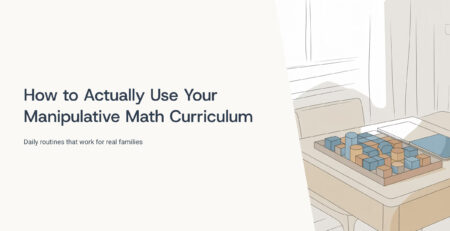
Now don’t build a row from it, or a wall, or a tower. Instead, grow outward: place a triangle on each of its four sides, so the square becomes a four-pointed star. Then another ring — triangles between the triangles, until the star fills in. Then a ring of squares around the outside.
Each ring wraps the one before, and the little square at the centre never moves. What you end up with isn’t a shape you built up like a brick wall. It’s a shape that opened, from the middle out, like something growing.
Picture a moment like this one: a child who has added a ring of triangles around her centre square leans over the pattern, turns her whole body to reach the far side, and — without being told — places the next piece not just anywhere, but exactly opposite the one she set down a moment ago, keeping the whole thing turning evenly around its middle. She’s not filling a space. She’s growing a thing, ring by ring, and some part of her knows it has to grow evenly or it isn’t right.
That instinct — to build outward from a centre, evenly, in rings — is one of the deepest patterns in all of nature, and Fröbel built the direction of it into the very core of his method.
Here’s the idea. Most building a child does moves in a line or a stack — you add to the end, or you add to the top. But Fröbel’s flat pattern work, his parquetry tablets — the very squares and triangles this activity uses — grows a different way: from the inside out. He was insistent on this. His whole sequence of materials, his scholars note, deliberately keeps the order “from the inside to the outside” — and the special pattern boards he designed have a marked middle square, placed there precisely because the beautiful patterns are meant to be grown outward from the centre. You don’t start at a corner and fill toward the edges. You start at the heart and open outward, ring by ring.
And this isn’t an arbitrary rule — it’s how the living and physical world actually builds itself. A flower grows radially, petal-ring around petal-ring, from a single central point. A snowflake forms outward from one seed of ice, six arms growing together, evenly, from the middle. A tree’s trunk adds a ring a year, each wrapping the last, the centre staying put. Ripples spread outward from where the stone fell. Over and over, nature builds by starting at a centre and growing outward in even rings — and a child growing a pattern from a middle square is doing, with her hands, the same thing a flower does with its petals. I’ve come to call it The Opening — a pattern grown outward from its centre, ring by ring, the way living things actually grow.
There’s a real skill hidden in it, too, and it’s the one the activity names: a sense of direction. To keep the pattern growing evenly, the child has to read each new position in relation to the centre and to what’s already there — this piece goes opposite that one; this ring mirrors the last. She’s not just making it pretty. She’s learning to orient herself in space, to hold a centre and place everything in relation to it, which is the beginning of every kind of spatial reasoning there is.
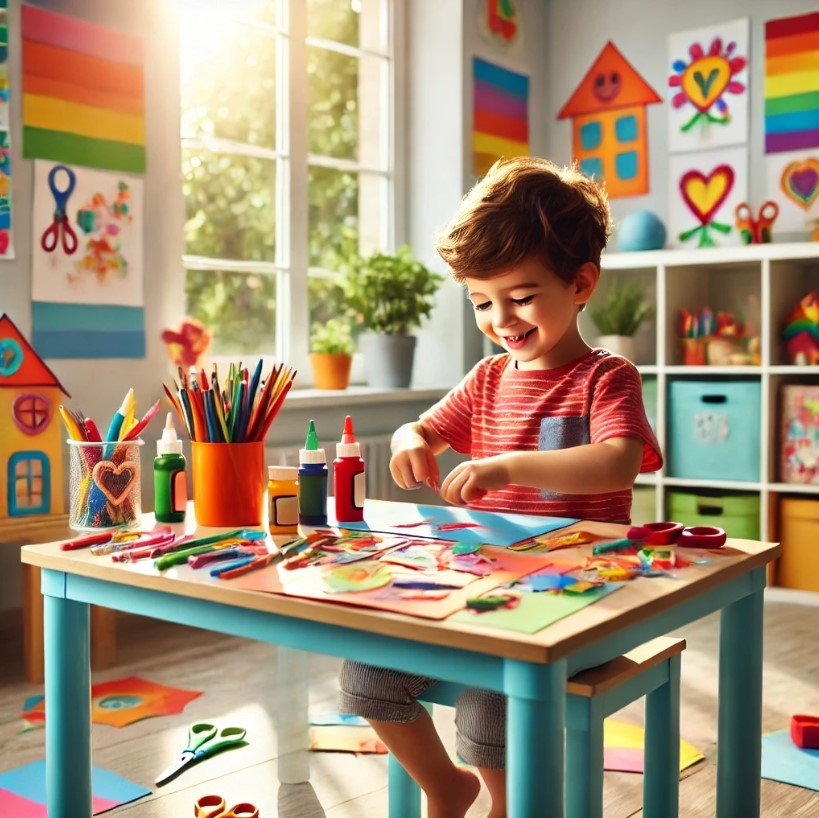
So here’s the activity for this week, and it costs you some paper and scissors. Cut a stack of squares and a stack of triangles (halve some of the squares diagonally). Put one square in the middle of the table. Then grow outward: a triangle on each side, then a ring between them, then a ring of squares — always working from the centre out, always keeping it even all the way around. The one rule that makes it work is Fröbel’s own: don’t tear it down to start again. If your child wants to change it, let her grow the next ring differently rather than sweep it away — develop the pattern outward, the way it’s been growing.
Don’t direct where each piece goes. The whole point is that she develops the eye — and the turning-of-the-body — to keep a pattern growing evenly around its own centre. Your job is to place the first square in the middle and then let her open the rest.
Which leaves a question, and it isn’t about her pattern. It’s about you. We’re mostly taught to build our lives outward-in — to start from the edges, the outer expectations, the shape other people can see, and work inward, hoping a centre turns up eventually. But a flower doesn’t grow that way, and neither does a snowflake, and neither, maybe, does a life that holds together.
What’s the centre yours is growing from — the one still square everything else arranges itself around — and are you building outward from it, or are you starting at the edges and hoping? The child who knows, in her hands, that you begin from the middle might have the better instinct.
Thursday, members get the full version: the radiating-pattern game across three age gaps — from a toddler simply placing a ring of shapes around a centre, to an older child discovering why snowflakes always have six arms and never five, and how the number of “arms” a pattern can have is fixed by geometry itself.
Saturday, the framework beneath it: Fröbel’s principle of growing “from the inside out,” why radial growth runs from the crystal to the flower to the child’s own development, and what it means to build a life — and raise a child — from the centre outward.





LEAVE A COMMENT