

Pattern Recognition and Children: Why Fröbel Treated Symmetry as Mathematical Thinking (Not Just Art)
For parents who’ve watched their child quietly arrange objects into patterns and wondered what was actually happening — this post explains the cognitive science Fröbel identified 200 years ago, and why it matters for your homeschool today.
Picture a moment like this one — the kind practitioners describe again and again.
A child is sitting at the kitchen table with a small collection of objects. Leaves, maybe, or bottle caps, or the wooden blocks that have been living in a basket in the corner. Nobody asked them to do anything. There’s no activity planned. They just began — quietly, purposefully — arranging things into a pattern. Moving one piece. Stepping back. Moving it again. There’s something almost ceremonial about it, the care they’re taking. When you lean in and ask what they’re making, they look up briefly and say, with complete seriousness: “I’m making it right.”
Making it right. Not making it useful. Not making it correct. Making it right — which turns out to mean: symmetrical, balanced, ordered. Beautiful, in the particular way that children understand beauty before anyone has taught them what beauty is supposed to look like.
Most parents see this and think: how sweet. How creative. Isn’t it lovely that they enjoy arranging things.
Fröbel saw it and thought something different. He saw one of the deepest forms of mathematical thinking available to a developing human mind — and he built an entire educational sequence around protecting it.
What Pattern Recognition Actually Is

Here’s what surprises most people when they first encounter Fröbel’s thinking on this: he did not treat the creation of symmetrical patterns as an artistic activity. He treated it as a cognitive one.
Play is the Life of a Child — the most comprehensive guide to Fröbelian practice available today — makes the relationship between beauty and intelligence explicit: “The formation of symmetrical patterns contributes to the development of aesthetic appreciation. Of no less importance, however, is the fact that the development of patterns is a prerequisite for the development of pattern recognition — a basic characteristic of human intelligence.”
Read that again. Pattern recognition — the ability to identify relationships, detect regularities, predict what comes next — is described not as a nice extra but as a basic characteristic of human intelligence. And the route to it, Fröbel argued, runs directly through the child’s impulse to create symmetry with their hands.
This is The Pattern-Intelligence Connection: the link between a child’s aesthetic impulse — the felt sense that something looks right when it is balanced and ordered — and their developing capacity for mathematical and scientific reasoning. The child who spends twenty minutes making a symmetrical arrangement with autumn leaves is not decorating. They are training one of the most sophisticated cognitive capacities they possess.
Why This Gets Interrupted
The reason this matters for your homeschool is that the pattern-making impulse is one of the most commonly interrupted activities in a child’s day — precisely because it looks so unproductive.
A child sitting quietly arranging blocks into a symmetrical design appears, from the outside, to be doing nothing in particular. There is no obvious learning outcome. No question being answered. No skill being drilled. The activity looks like filler — something that happens in the gaps between real learning.
Fröbel’s concern was that teachers and parents, failing to recognise what was actually happening, would interrupt it in favour of something that looked more obviously educational. In Froebel as a Pioneer in Modern Psychology, E. R. Murray documents exactly this failure in early Fröbelian practice: teachers “wearied and stupefied children with mathematical forms for which they were not ready, and forced upon them symmetrical designs when their souls hungered for” something else entirely. The mistake ran in both directions — forcing symmetry when the child wasn’t ready, and interrupting it when the child had arrived there naturally.
The natural arrival is the one worth protecting. A child who has independently chosen to create a symmetrical pattern — who is moving pieces, checking the balance, adjusting until it feels right — is doing something that no imposed symmetry exercise can replicate. The aesthetic judgment is the cognitive work. The felt sense of rightness is the intelligence in action.
What This Looks Like in Practice
The kind of moment that makes this visible is specific and quiet. A child working on a pattern will pause, tilt their head slightly, and look at what they’ve made from a slight distance — the way a painter steps back from a canvas. Then they’ll move one piece. Not randomly — deliberately. They’ll place it, check it, and either leave it or move it again. This checking and adjusting is not indecision. It is the child running an internal symmetry test, comparing what they see against an internal standard of balance they have developed through repeated experience with pattern.
That internal standard is what Fröbel wanted to cultivate. Not the ability to copy a pattern shown to them. Not the ability to follow a symmetry rule explained in advance. The felt, embodied, personally developed sense of what balanced and ordered looks like — which is, when you trace it forward, the same sense that underlies mathematical intuition, musical ear, and scientific elegance in adult life.
One Thing to Try This Week

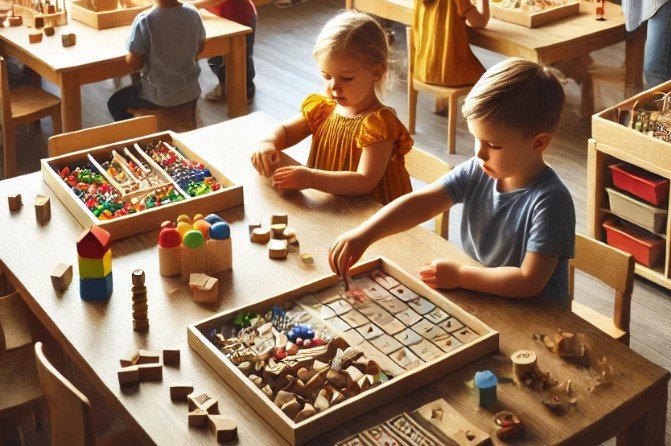
Set out a collection of objects on a low tray — anything you have. Leaves, stones, coins, buttons, pasta shapes, blocks, lids. Aim for variety in shape and colour but don’t over-curate. The collection should feel abundant rather than precious.
Place the tray somewhere accessible — not at the table, not presented as an activity. Just available. On the floor, on a low shelf, in the middle of a room your child passes through.
Then leave it alone for a day and see what happens.
What you’re looking for is not whether they engage with it immediately. You’re looking for whether they return to it — whether the tray pulls them back across the day, draws them into an arrangement they need to adjust, produces that specific quietness that comes when something genuinely interesting has claimed a child’s attention.
When they do engage: don’t comment on what they’re making. Don’t suggest improvements. Don’t name the pattern type. Just sit nearby, and if they look up, look back with genuine interest — not evaluation. Let the felt sense of rightness develop without interruption.
That rightness, protected and repeated, is what the full lesson guide builds on directly.
Before You Move On
Think about the last time something felt right to you — not correct, not finished, but genuinely right. Balanced. Complete. What was it, and how did you know?
Spielgaben Homeschool publishes every Tuesday, Thursday, and Saturday. Free subscribers receive the weekly Tuesday post. Paid members ($9/month) receive the full lesson guide, printable, and Saturday framework.





LEAVE A COMMENT