
Movement Games and Community: Building Social Bonds and Physical Joy
Here’s a scene that plays out in homeschools everywhere.
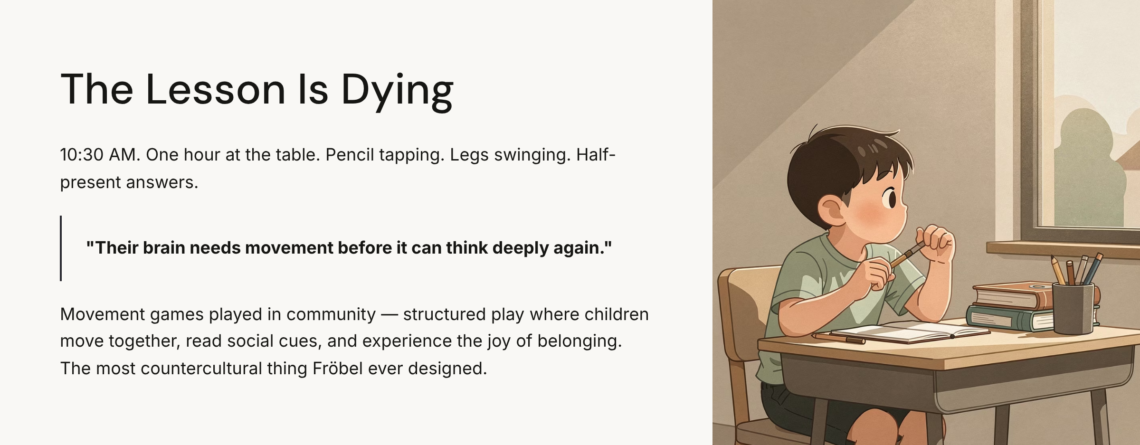
It’s 10:30 in the morning. Your child has been sitting at the table for an hour. The maths lesson started well, but now they’re fidgeting. Tapping their pencil. Swinging their legs. Staring out the window. You repeat the question. They give a vague, half-present answer. The lesson is dying—and you can feel your patience dying with it.
You have two choices. Push through and teach them that learning means enduring discomfort. Or stop everything, stand up, and move.
Fröbel would tell you to move. Every time. Without guilt.
Not because the lesson doesn’t matter. But because the child’s body is telling you something their words can’t: their brain needs movement before it can think deeply again. And in a world that increasingly asks children to sit still, stare at screens, and absorb content passively, the ability to move—with purpose, with others, with joy—isn’t a break from learning. It’s what makes deep learning possible.
Today, we arrive at the final article in our Fröbel Masterclass series. We’ve explored the Gifts, the Occupations, the garden, and animal care. But there’s one element we haven’t touched—the one Fröbel considered essential to raising children who can think for themselves, connect with others, and resist the pull of passive existence.
Movement games played in community.
These aren’t PE lessons. They aren’t sports. They aren’t competitions with winners and losers. They’re something older, simpler, and far more powerful: structured play where children move their bodies together, learn to read social cues, and experience the deep human joy of belonging to a group.
In a distracted world that’s training children to be solitary consumers of content, this might be the most countercultural thing Fröbel ever designed.
Movement Is Not a Reward. It’s a Requirement.
Let’s clear something up first, because this misconception runs deep—even in homeschool families who’ve rejected most of conventional schooling’s assumptions.
Movement is not a break from learning. It’s not a reward for finishing work. It’s not something children “earn” by sitting still long enough. It’s not recess.
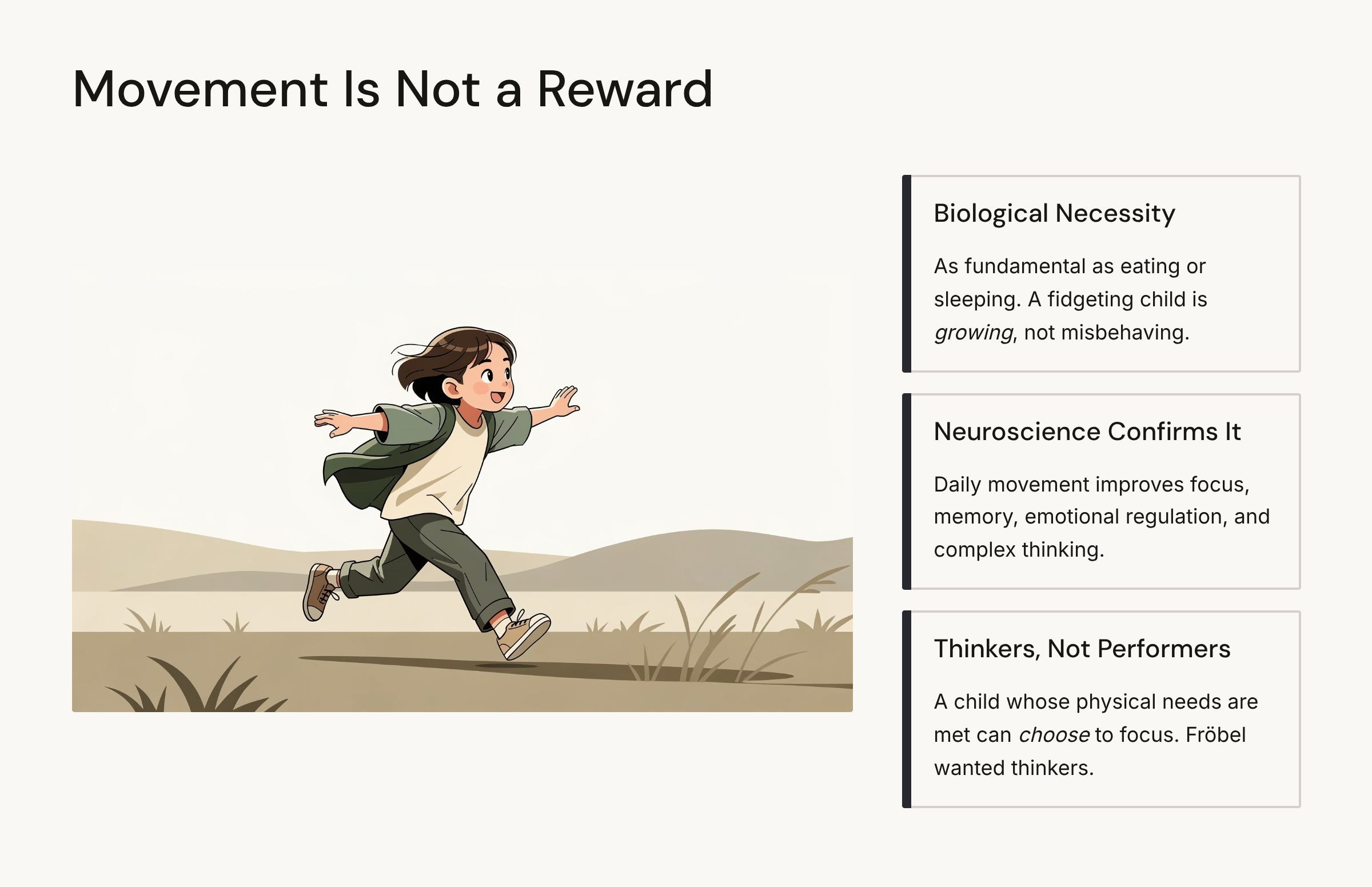
Movement is a biological necessity. Fröbel recognised that the urge to move—especially during phases of physical growth—is as fundamental as the urge to eat or sleep. A child who can’t sit still isn’t misbehaving. They’re growing. And their growing body is demanding exactly what it needs: physical action.
Modern neuroscience has confirmed what Fröbel intuited over 180 years ago: movement is a gateway to the brain. Daily physical activity directly enhances cognitive performance. It improves focus, memory, emotional regulation, and the ability to process complex information. It also creates a better social climate for learning—children who move together cooperate better, communicate more effectively, and resolve conflicts more easily.
What this means for your homeschool: If the lesson is stalling, the answer isn’t more discipline. It’s more movement. Five minutes of purposeful physical play can reset your child’s capacity for deep thinking more effectively than any motivational speech or consequence. Build movement into the fabric of your day, not as an interruption but as an essential ingredient.
And here’s the part that matters for raising deep thinkers: a child whose physical needs are met is a child who can choose to focus. A child whose physical needs are ignored is a child who is fighting their own body just to pay attention. The first child thinks deeply because they’re free to. The second child performs compliance because they have to. Fröbel wanted thinkers, not performers.
Why “Together” Changes Everything
You could send your child outside to run around the yard alone. That would help with the fidgeting. It would burn energy. It would improve their mood.
But it would miss the deepest purpose of Fröbelian movement games.
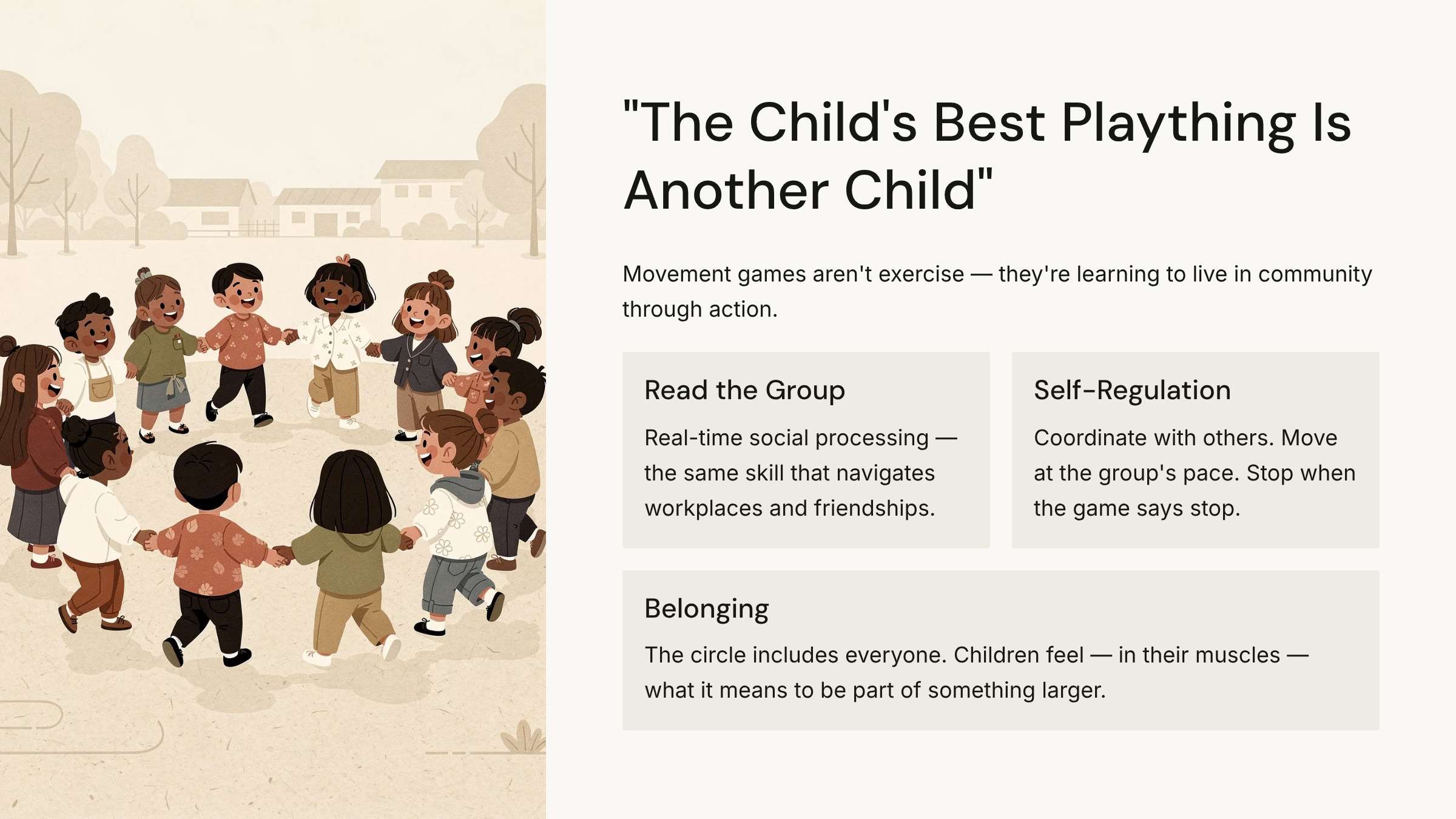
Fröbel believed that “the child’s best plaything is another child.” Movement games aren’t primarily about exercise—they’re about learning to live in community through action rather than words. They’re what he called “the prelude to human life.”
Think about what happens in a group movement game. Your child has to:
Read the group. What are the others doing? Where are they moving? What’s the rhythm? This is real-time social processing—the same skill that will later help them navigate workplaces, friendships, and relationships.
Coordinate their body with others. Hold hands without squeezing too hard. Move at the group’s pace, not just their own. Stop when the game says stop, even if they want to keep going. This is self-regulation learned through the body, which is how young children learn it best.
Take turns being the centre of attention—and being part of the background. Sometimes they lead. Sometimes they follow. Both roles are essential, and the game makes both feel natural rather than forced.
Experience belonging. The circle includes everyone. The game works because everyone participates. Your child feels, in their muscles and their movement, what it means to be part of something larger than themselves.
In a culture that increasingly isolates children—each one on their own device, consuming their own algorithmically curated content, interacting through screens rather than bodies—these experiences are becoming rare. And their rarity makes them more valuable, not less.
Fröbel’s movement games are an antidote. They teach children that joy comes from being with others, not from consuming content near others. That connection is physical, not digital. That community is built through shared action, not shared screens.
The Power of the Circle
The most iconic shape in Fröbelian movement games is the circle. And that’s not accidental.
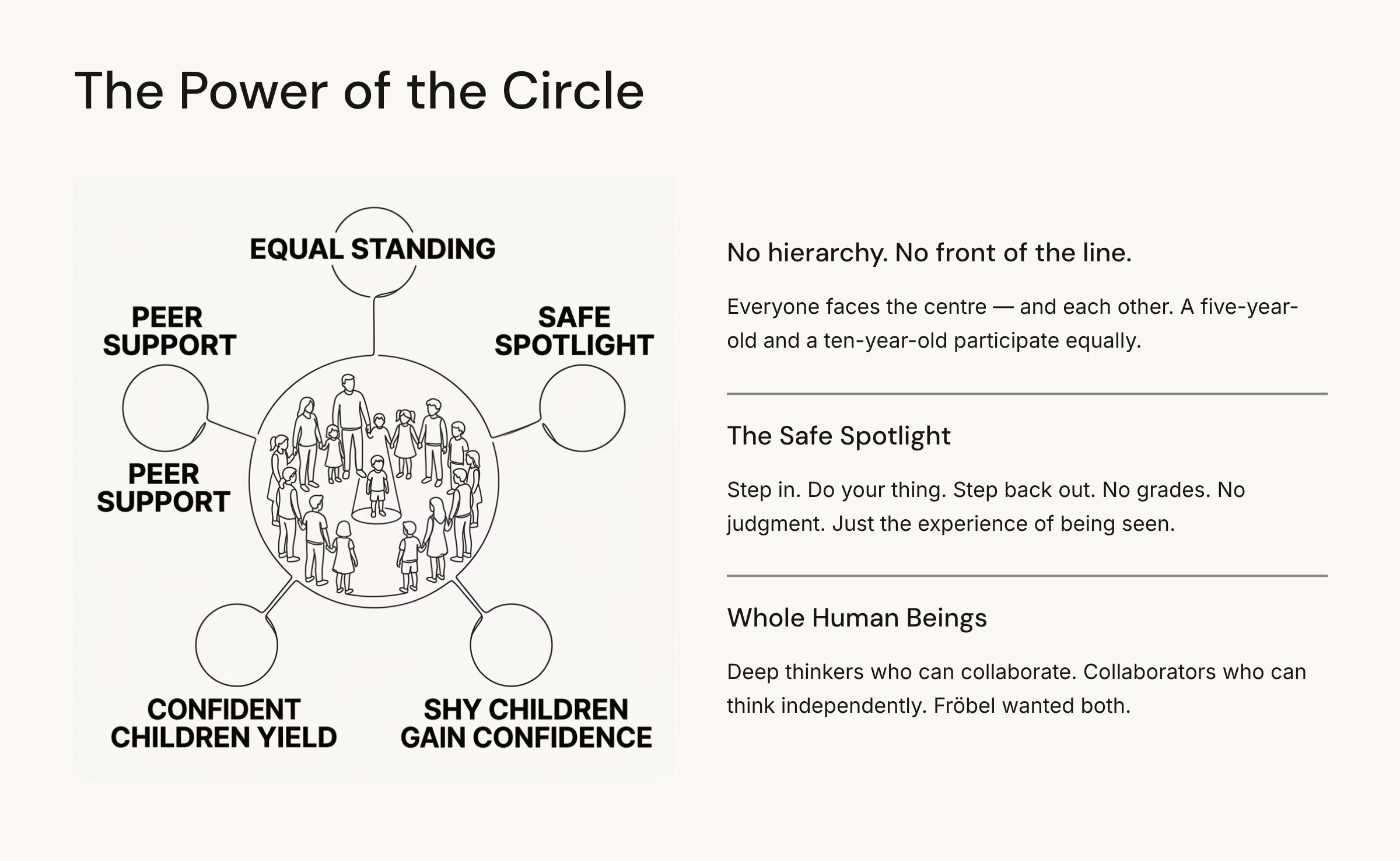
A circle has no head and no tail. No front of the line. No back of the class. No hierarchy. Everyone faces the centre—and everyone faces each other. The parent stands in the circle alongside the children, not above them. The oldest child stands next to the youngest. Everyone is equal.
For homeschool families—especially those with children of different ages—the circle is a gift. A five-year-old and a ten-year-old can participate in the same game, at their own level, without either feeling inadequate or bored. The circle accommodates difference without creating ranking.
And when a child steps into the centre—to perform a movement, to act out an animal, to complete a challenge—they experience something crucial: the safe spotlight. They’re the centre of attention in a space that is loving, supportive, and temporary. They step in, they do their thing, they step back out. No grades. No judgment. Just the experience of being seen and then releasing it.
For shy children, this is transformative. The circle gives them a low-stakes way to practise being noticed—surrounded by people who are on their side. For confident children, it gives them practice yielding the spotlight—stepping back into the circle and supporting someone else’s moment.
Both lessons are essential for raising children who can think independently and function in community. Deep thinkers who can’t collaborate are isolated. Collaborators who can’t think independently are followers. Fröbel wanted neither. He wanted whole human beings.
Three Games to Try in Your Homeschool
Here are three classic Fröbelian movement games, adapted for homeschool families. Each one works with as few as three participants (parent plus two children) and scales up beautifully for co-op groups, playdates, or extended family gatherings.
1. The Pigeon House (Ages 2–10)
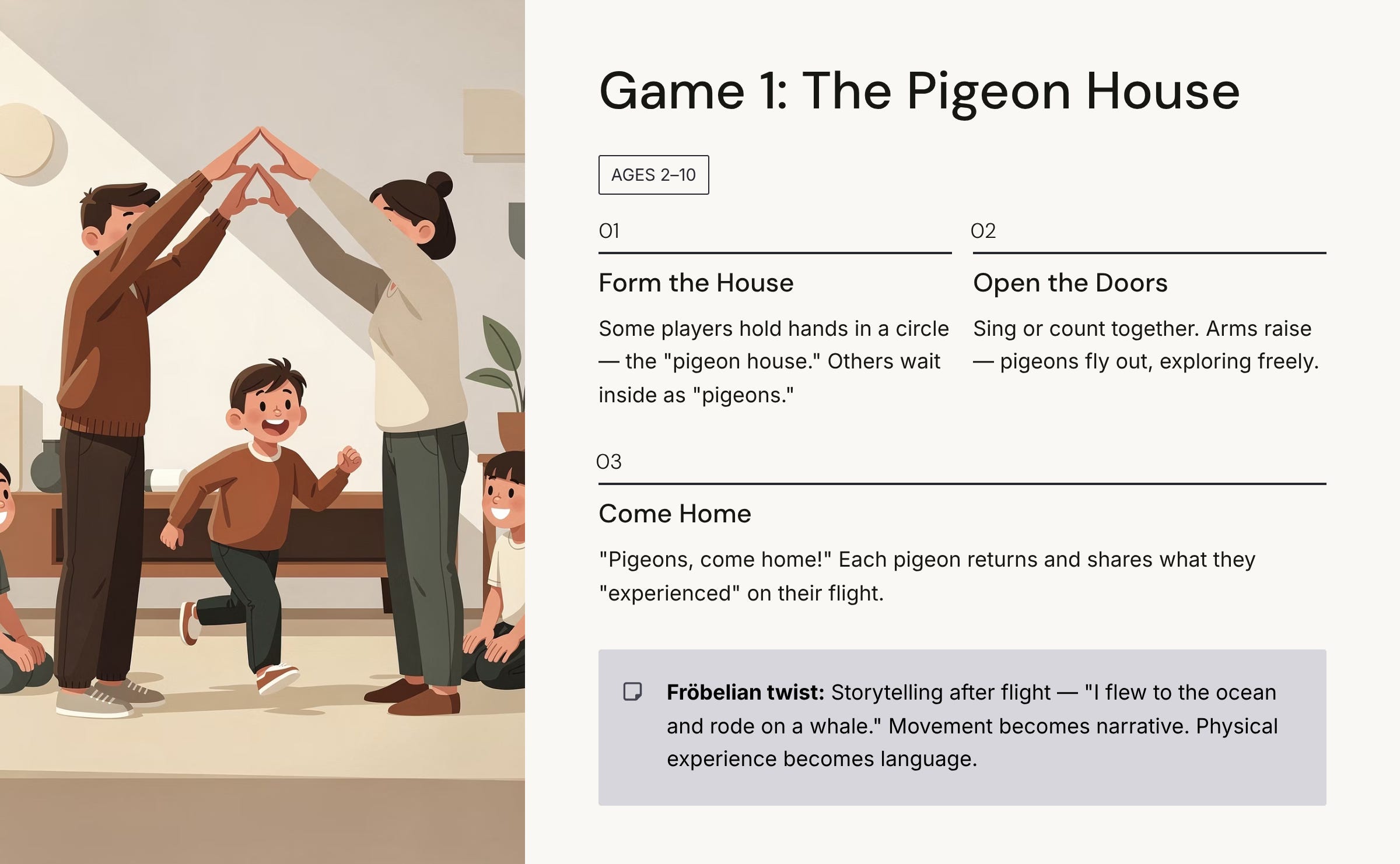
This is one of Fröbel’s most beloved games, and it’s a beautiful living picture of his concept of “Life Unity”—the balance between the safety of the family “nest” and the adventure of the wide world.
How to play:
Some family members form a circle by holding hands—this is the “pigeon house.” The remaining players are “pigeons” and wait inside the circle.
Sing or chant together (any simple song works—or just count to ten). When the song ends, the circle players raise their arms and “open the doors.” The pigeons “fly” out into the room or yard, flapping their arms, exploring freely.
After a set time (count to twenty, or sing a second verse), call out “Pigeons, come home!” The circle players lower their arms, the pigeons fly back inside, and the doors close.
The Fröbelian twist: When the pigeons return to the circle, each one tells the group what they “experienced” on their flight. “I flew to the mountain and saw a waterfall.” “I flew to the ocean and rode on a whale.” This turns a movement game into a storytelling exercise—and for toddlers who are developing language, it’s a wonderful, low-pressure way to practise narrative.
What children learn: The courage to leave safety and explore. The comfort of returning to a welcoming home. The ability to translate physical experience into words. And for the children forming the circle: the experience of being the safe place—of holding the door open and welcoming others back.
Variations by age:
- Toddlers (2–3): Keep the “flights” very short. The joy is in the leaving and returning. Stories can be one sentence: “I saw a tree!”
- Young children (4–6): Extend the flights. Add obstacles in the room (cushions, chairs) that pigeons must navigate around. Stories become more elaborate.
- Older children (7–10): The “pigeons” can be given specific missions: “Find something blue.” “Count how many steps to the door and back.” “Bring back a leaf from outside.” This adds cognitive challenges to the physical game.
2. Small Thread, Small Thread (Ages 4–10)
This game uses a line of people to symbolise community and coordinated movement. It’s particularly powerful because it physically demonstrates how individuals become a unified group.
How to play:
Everyone joins hands in a long line. One person at the end stands still—they are the “spool.” Following a chant or song, the line begins to wind itself around the spool, spiralling tighter and tighter until everyone is standing close together, wrapped around the centre.
Pause here. Everyone is packed in tight. “We’re all together. Can you feel how close we are?”
Then two people at the outer edge raise their arms to form a “gate.” The spool person leads the line through the gate, unwinding the spiral. The line eventually reforms into a circle—a new shape that emerged from the journey.
What children learn: How to move carefully as part of a unit. The feeling of coming together (winding) and opening up (unwinding). The experience that a group can change its shape without losing its members. And the physical, felt sense that they are literally connected to the people on either side of them.
Why this matters for deep thinkers: In a world that rewards individual achievement and personal branding, children rarely experience what it feels like to be one thread in a larger fabric. This game gives them that experience in their bodies—not as a lesson about teamwork, but as a living feeling of interdependence.
Practical tips:
- Move slowly. The spiral gets tight, and younger children need time to navigate without tripping.
- If you have very young children mixed with older ones, place the younger ones in the middle of the line where they can follow the movement without leading.
- The game works indoors or outdoors. Outdoors is better for larger groups, as the spiral needs room.
3. Everyone Flies High! (Ages 3–10)
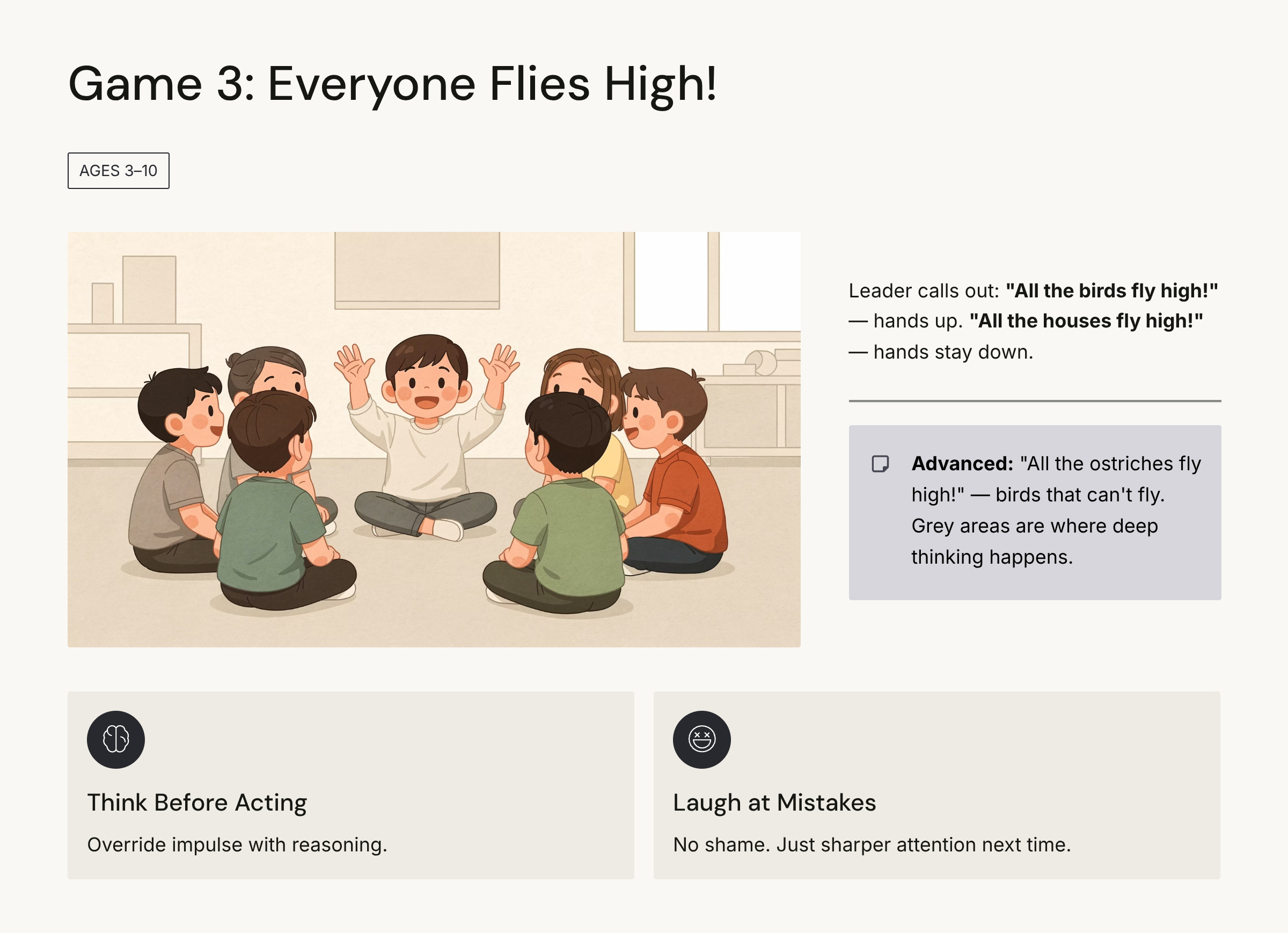
This is a “hand and finger game” that trains the brain-body connection—and it’s perfect for rainy days, small spaces, or moments when you need quick, focused physical engagement without a lot of room.
How to play:
Everyone sits in a circle with their hands resting flat on the floor (or on a table). The leader calls out: “All the birds fly high!” Everyone quickly raises their hands in the air—because birds can fly.
Then: “All the butterflies fly high!” Hands go up again—correct.
Then: “All the houses fly high!” If a child raises their hands, the group laughs together. Houses can’t fly. The child realises the mistake, laughs too, and learns to listen more carefully next time.
Continue with a mix of things that fly (bees, aeroplanes, kites, bats) and things that don’t (elephants, rocks, tables, shoes). Increase the speed as children get better.
What children learn: To process information quickly before acting on it. To override an impulse (everyone else is raising their hands—should I?) with their own reasoning. To laugh at their own mistakes without shame. And to maintain focus under playful pressure.
Why this matters for raising deep thinkers: This game is, at its core, training children to think before they react. In a world that bombards them with stimuli designed to trigger automatic responses—notifications, clickbait, autoplay videos, outrage cycles—the ability to pause, process, and choose is becoming one of the most valuable cognitive skills a person can have. Fröbel trained it through a simple game with hands on the floor. The principle is timeless.
Variations:
- For younger children: Use simple, obvious categories. Animals that can fly vs. animals that can’t. Keep the pace slow.
- For older children: Make it tricky. “All the ostriches fly high!” (They’re birds but can’t fly.) “All the flying fish fly high!” (They glide but don’t truly fly—debate it!) This introduces nuance and grey areas, which is exactly where deep thinking happens.
- Advanced version: Children take turns being the leader. Designing tricky prompts requires even more careful thinking than responding to them.
Rules and Freedom: The Fröbelian Balance
Here’s a principle that applies to every game above—and to your homeschool more broadly.
Fröbel’s approach to rules was precise: set only as many as are necessary for safety and harmony, and leave as much freedom as possible for children to be joyful and “boisterous.”
This is not permissiveness. It’s intentional minimalism. Too many rules kill spontaneity and turn play into compliance. Too few rules create chaos and anxiety. The sweet spot—Fröbel’s sweet spot—is a clear, simple structure within which children are free to express themselves fully.
In practice, this means:
- “Stay inside the circle” is a rule. “Stand perfectly still” is unnecessary.
- “When the song ends, come back” is a rule. “Run exactly this way” is unnecessary.
- “Raise your hands only if it can fly” is a rule. “Sit up straight while playing” is unnecessary.
Children don’t need many rules. They need clear rules. And within those clear boundaries, they need the freedom to be loud, silly, energetic, and fully alive.
This balance—structure that enables freedom, not structure that replaces it—is the hallmark of Fröbelian education. And it’s the balance that produces deep, independent thinkers: children who understand the rules well enough to operate freely within them, rather than children who follow instructions because they’ve been trained to obey.
What Movement Games Build That Screens Cannot
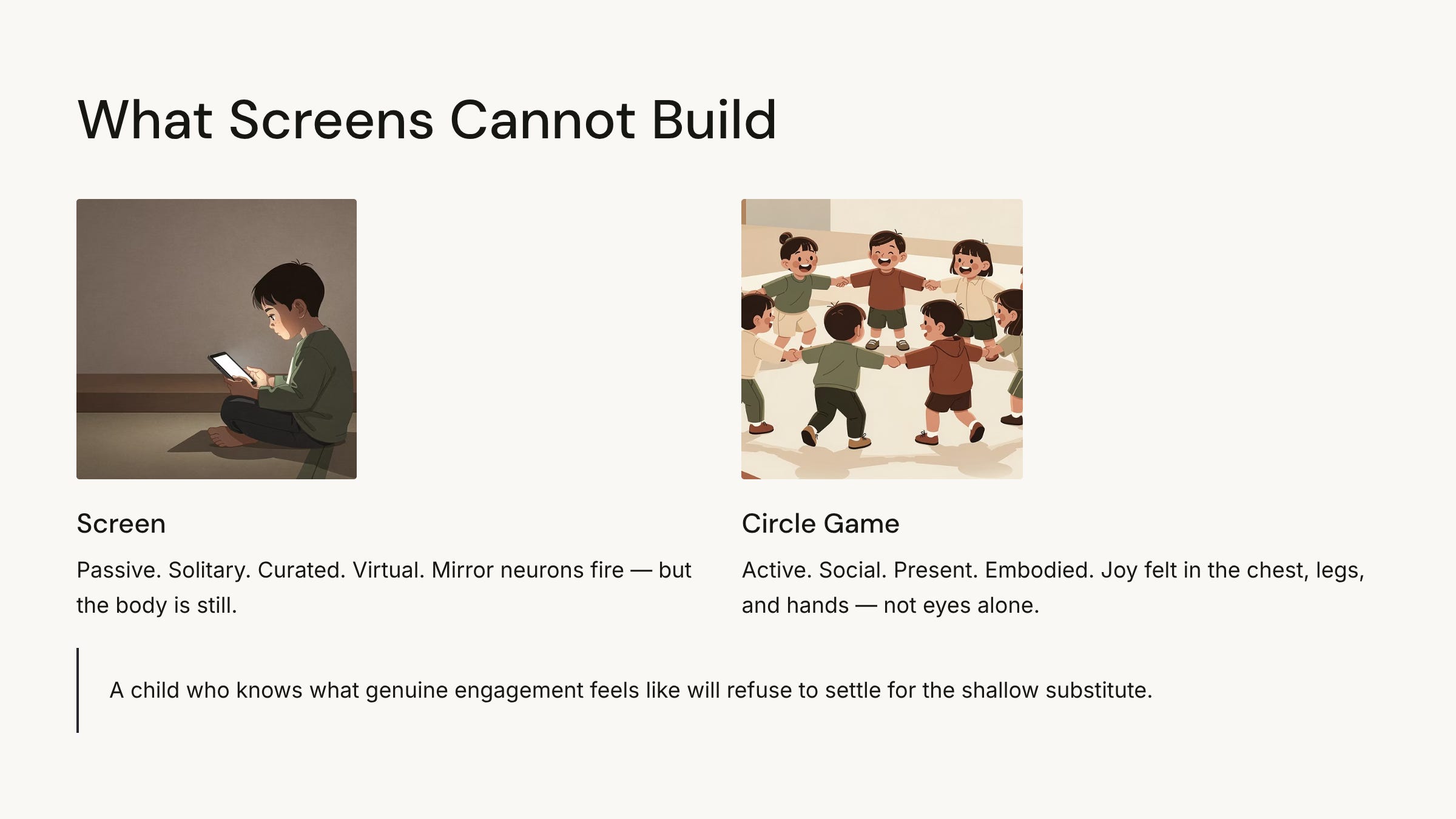
Let’s name it directly, because this is the heart of why these games matter now more than they’ve ever mattered.
A child watching a YouTube video is receiving movement. They see characters run, jump, dance, and play. Their mirror neurons fire. They might even feel excited.
But their body is still. Their muscles are passive. Their social brain is disengaged. They’re consuming an image of community without experiencing it. They’re watching play without playing.
A child in a Fröbelian circle game is doing the opposite of everything screens do:
Active, not passive. Their body is moving, their muscles are engaged, their coordination is developing in real time.
Social, not solitary. They’re reading faces, matching rhythms, negotiating space with real people who respond unpredictably—not characters who follow a script.
Present, not curated. The game is happening now. It can’t be paused, rewound, or optimised. Their attention must be here, in this room, with these people, in this moment.
Embodied, not virtual. The joy they feel is in their chest, their legs, their hands. Not in their eyes alone.
This isn’t anti-technology. It’s pro-childhood. Fröbel’s movement games give children experiences that their growing brains and bodies are designed for—experiences that no screen, however well-designed, can replicate. And in a world where passive consumption is the default mode for most children’s leisure time, deliberately choosing active, embodied, communal play is one of the most important things a homeschool family can do.
You’re not just getting your kids moving. You’re raising children who know—in their bodies, not just their minds—that real joy comes from real connection. That’s the foundation of deep, independent thinking: a child who knows what genuine engagement feels like and refuses to settle for the shallow substitute.
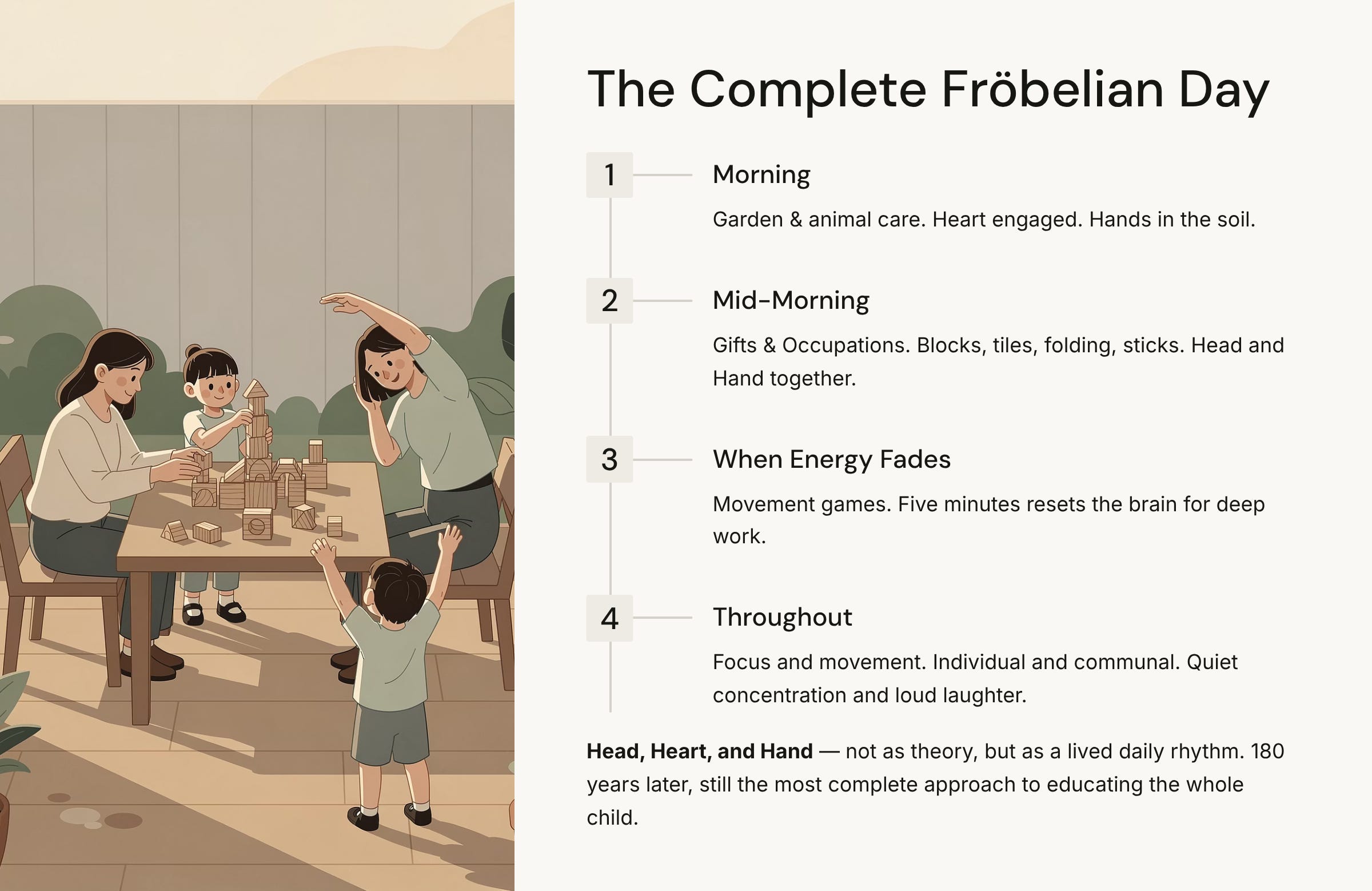
Bringing It All Together: The Complete Fröbelian Day
Spielgaben Homeschool is a reader-supported publication. To receive new posts and support my work, consider becoming a free or paid subscriber.
We’ve reached the end of our Masterclass series. And from here, looking back over the entire journey, you can see the shape of a complete Fröbelian homeschool day.
Morning: The garden and animal care. Your child starts the day with living things—watering plants, feeding animals, observing nature. The Heart is engaged. The hands are in the soil. The day begins with care, not curriculum.
Mid-morning: The Gifts and Occupations. Building with blocks, laying tiles, folding paper, constructing with sticks and peas. The Head is engaged alongside the Hand. Mathematical, scientific, and artistic thinking develop through purposeful play.
When energy fades: Movement games. Step away from the table. Form a circle. Play The Pigeon House or Everyone Flies High. Five minutes of physical, social play resets the brain for the next period of concentrated work.
Throughout the day: The rhythm of focused work and joyful movement, of individual exploration and communal play, of quiet concentration and loud laughter.
This is Head, Heart, and Hand—not as a theory, but as a lived daily rhythm. This is what Fröbel designed. And 180 years later, it’s still the most complete approach to educating the whole child that exists.
What Comes Next
Over the past weeks, we’ve built something together.
We’ve explored the philosophy—Fröbel’s life, the Law of Opposites, Head, Heart, and Hand. We’ve worked through the practice—from the First Gift to the Divided Cubes, from Parquetry to Paper Folding to Stick and Pea Work. We’ve stepped outside into the garden and explored animal care. And today, we’ve completed the picture with movement and community.
But we’re not done.
Because the question every thoughtful homeschool parent is asking right now is: how does a 200-year-old philosophy hold up in a world of iPads, algorithms, and infinite distraction?
The answer might surprise you.
In our next series—Fröbel in the Modern World—we start with the question every family is wrestling with: Digital Media Through a Fröbelian Lens. How do you navigate screens, apps, and online content when your educational philosophy is rooted in wooden blocks, garden plots, and circle games?
Fröbel never saw a smartphone. But his principles give you everything you need to make wise decisions about one.
That series starts next week. And if you’ve made it this far—through fourteen weeks of Masterclass content—you’re exactly the kind of parent it’s written for: one who wants their child to think deeply, not just perform well, in a world designed to distract them.
This is part of our Fröbel Gifts and Occupations Masterclass. Thank you for being here.
Subscribe here so you don’t miss the start of our new series: Fröbel in the Modern World.



LEAVE A COMMENT