
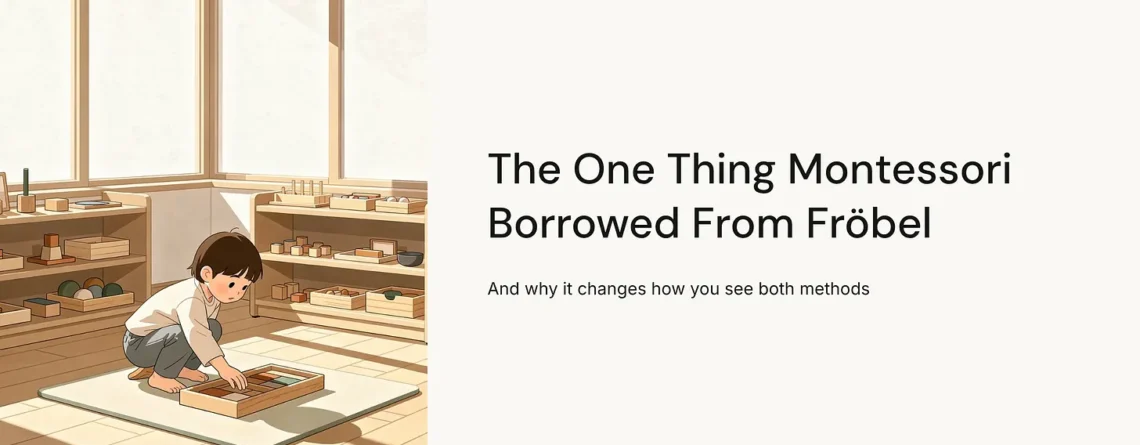
The One Thing Montessori Borrowed Directly From Fröbel — And Why It Changes How You See Both Methods
Here’s something most homeschooling parents don’t know.
Before Maria Montessori opened her first Casa dei Bambini in Rome in 1907, she studied Fröbel’s kindergartens. She read his work carefully. She observed his methods in practice. And when she sat down to design her own approach to early childhood education, she carried several of his core ideas with her.
Understanding where those ideas came from doesn’t diminish Montessori. It makes both methods more useful to you.
Fröbel Said It First
If you’ve spent time in Montessori circles, you’ve heard the phrase “prepared environment” — the idea that the physical space around a child is not neutral. It’s either helping or hindering their development, so you design it deliberately. Materials at child height. Uncluttered shelves. Activities arranged from simple to complex. Beautiful, natural objects over plastic and noise.
This feels unmistakably Montessori. But Fröbel said it first.
In the 1830s — seventy years before Montessori — Fröbel was writing about the environment as a teacher in its own right. He chose materials with care, arranged spaces to invite exploration, and believed that children learn through what surrounds them, not just through what adults tell them.
The prepared environment didn’t begin with Montessori. It began with Fröbel.
Where They Agree
Both educators observed the same fundamental truth: children are not passive recipients of knowledge. They are active constructors of it.
Left in a thoughtfully arranged space with well-chosen materials, a child will teach themselves things no lesson plan could deliver as effectively. This shared conviction — called constructivism in educational research — has one practical implication above all others:
What you put in front of your child matters more than what you say to them.
The environment is the lesson. Your role is to design the conditions for discovery, then get out of the way.
Where They Differ
Here’s where it gets useful. Fröbel emphasises creative, symbolic play. Montessori emphasises purposeful, real-world activity.
For Fröbel, a block can be a house, a mountain, a mathematical unit — whatever the child’s imagination needs it to be. Symbolic thinking is the foundation of language, mathematics, and creative thought, and play is the vehicle.
Montessori took a different view. Her materials tend toward the literal and functional — children pour real water, sweep real floors, use real tools. Imagination is valued, but independence and mastery of real-world tasks take priority.
Neither approach is wrong. They serve different developmental needs. Fröbel’s symbolic, creative emphasis is particularly powerful in the early years — roughly ages two to seven. Montessori’s practical rigour becomes increasingly valuable from age five or six onward, as children’s thinking becomes more logical and their drive toward genuine competence grows.
The smartest homeschooling parents don’t choose between them. They use Fröbel to lay the creative foundation, then let Montessori build on top of it.
One Practical Shift for This Week
Look at the space where your child learns most often. Is it cluttered or clear? Are materials accessible at child height?
Pick one surface, remove half of what’s there, and see how your child responds. Then put out one simple, open-ended material — wooden blocks, a set of coloured balls, natural objects from outside — with no instructions.
Don’t tell them what to do with it.
That’s both Fröbel and Montessori at their most fundamental: trust the child, prepare the space, then watch.
Get the full lesson plan, printable PDF and activity guide free on Substack →
Each week on Spielgaben Homeschool, we decode Fröbel’s educational system into practical, ready-to-use guides for homeschooling families — including how to combine the best of both methods in your home.








LEAVE A COMMENT