
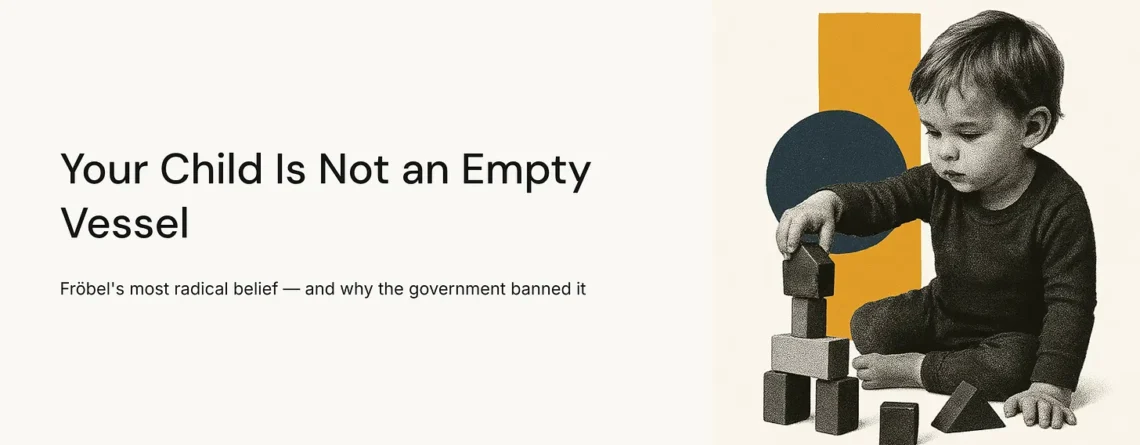
Your Child Is Not an Empty Vessel — Fröbel’s Most Radical Belief (and Why the Government Banned It)
In 1851, the Prussian government issued an emergency decree.
Kindergartens — all of them, across the country — were to be shut down immediately. Declared a threat to social order. Dangerous. Subversive.
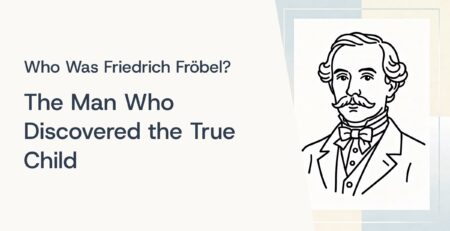
Friedrich Fröbel died the following year, aged 70, having watched his life’s work banned by the state.
What was so threatening? Not the wooden blocks. Not the gardens. Not the songs.
It was one idea. A single belief about children that, once you truly accept it, changes everything about how you educate them.
Children are not empty vessels waiting to be filled. They are complete human beings, carrying within them everything they need to become who they are meant to be.
The Model Most of Us Are Running Without Realising It
The empty vessel model assumes knowledge lives in the teacher, the child’s job is to receive it correctly, and a good educator is one who transfers content efficiently.
This model isn’t malicious. It’s just built on a particular assumption about what a child is.
Fröbel thought that assumption was wrong. Not slightly wrong — fundamentally wrong. Wrong in a way that damages children’s development when acted upon consistently over years.
What Fröbel Believed Instead
Fröbel’s starting point: every child arrives with an inner nature — a particular constellation of capacities and drives that are uniquely theirs. Not a blank page waiting for writing. More like a seed, already containing the program for what it will become.
Your job as an educator isn’t to write on that page. It’s to create the conditions the seed needs to unfold.
Follow this to its logical conclusion and you arrive somewhere genuinely disruptive: a curriculum that ignores a child’s inner nature isn’t just inefficient — it actively works against what’s trying to happen.
The Prussian government understood the implications perfectly. A child trusted to develop from within, rather than shaped from without, is harder to mould into a compliant subject. Fröbel’s kindergarten wasn’t just an educational method. It was a statement about what human beings fundamentally are.
What This Looks Like in Your Homeschool
Here’s the same situation through two different lenses.
Your seven-year-old abandons the maths lesson you’ve prepared and starts sorting blocks into elaborate colour patterns instead.
Empty vessel response: Redirect them back. The content needs to be delivered. The pattern sorting is a distraction.
Fröbel’s response: Watch what’s happening. Your child is doing mathematics — classification, pattern, sequence, spatial reasoning. Ask one question: “What are you making?” Then observe whether your lesson can emerge from what they’ve already started.
Neither response is always correct. But the default you reach for — the instinctive first response — reveals which model is running in the background. Fröbel wanted the default to be trust.
One Practice to Try This Week
Before your next learning session, sit quietly for two minutes and ask yourself one question:
“What is my child working on inside themselves right now — not academically, but developmentally?”
Not “what do they need to learn” — but “what is already trying to happen in them?”
Look at what they return to voluntarily. The questions they keep asking. The materials they reach for when given free time. Then ask: how does what I’ve planned today connect to what’s already moving in them?
When you find that thread, the lesson changes. Your child’s engagement changes. The quality of what happens in your homeschool changes.
That thread is what Fröbel was pointing at his entire life.
Get the full lesson plan, printable PDF and activity guide free on Substack →
Each week on Spielgaben Homeschool, we decode Fröbel’s educational system into practical, ready-to-use guides — including how to identify the signs of genuine self-directed learning and what your role looks like when you trust the child to lead.







LEAVE A COMMENT