

Open-Ended Toys: The Fröbel Test for What’s Actually Worth Keeping
If you keep buying open-ended toys that promise the world and then vanish under the couch by the afternoon, the problem probably isn’t the toy you chose — it’s a quality almost no toy aisle teaches you to look for. This is for any parent, homeschooling or not, who wants the one thing — drawn from Friedrich Fröbel’s philosophy — that makes a hands-on material genuinely worth keeping.
Most homeschooling parents are sure the problem is that they haven’t found the right material yet.
It isn’t.
You know the morning I mean. The new thing arrived during the week — the one with the glowing reviews, the word open-ended on the box, the promise of fourteen skills and forty-seven pieces. They tear into it. For twenty minutes, it’s wonderful.
By the afternoon it’s under the couch.
And the cardboard box it came in? That’s still going. It’s been a boat, a fort, a shop with everything priced, and a place to hide for three days running.
You’ve felt the small, specific sting of that. You spent the money, you read the reviews, you did the research — and the free thing won. So you do the natural thing. You assume the next material will be the one that finally holds them. The cart fills up. The shelf fills up. And underneath it all sits a quieter worry, the one that comes with teaching your own kids at home: that if they can’t settle on anything, it’s on you to fix it — with the right purchase, the right curriculum, the right something you haven’t found yet.
Here’s the part nobody tells you: the box didn’t win by accident. It won for the same reason it always wins. And once you see the reason, you’ll have a 60-second test you can run on the shelf you already own tonight — no buying required.

The more a toy does, the less your child does.
A toy that lights up, talks, and runs its own little show has already made every interesting decision before your child arrives. There’s nothing left to invent. They’re an audience. But a plain wooden block does nothing on its own — which means everything it becomes has to come from them. The box is empty, so they have to fill it. That emptiness is the feature, not the flaw.
This is the thing Friedrich Fröbel understood two hundred years ago, long before there was a screen to compete with. And he’s worth listening to for one reason above all: Fröbel is the man who invented kindergarten — the word and the idea both.
The whole notion of an intentional learning environment for young children, the thing you’re building at your own kitchen table every morning, started with him. So when he built his sequence of children’s materials, the striking thing is how deliberately plain they are.
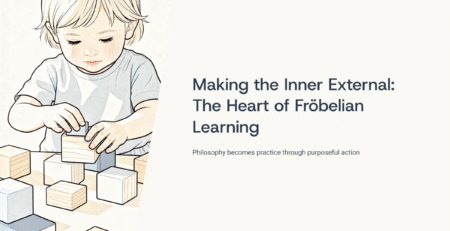
Plain wooden balls. Plain cubes. Few shapes, few colours, nothing that does a single thing by itself. He kept them stripped back on purpose, because he saw that simplicity is what hands the work back to the child.
So when you stand in front of the toy aisle — or your own shelf — the question isn’t which material. It’s one quality, and one only: how much can this thing become?
I call it the Becoming Test. Pick up any toy and ask one question of it: how many things can this become in my child’s hands?
A toy that can only ever be the one thing it already is — the talking dog that talks, the gadget that does its trick — fails. A basket of plain blocks passes without trying. For a five-year-old it’s a train, then soup, then a wall, then a row of sleeping animals.
For a nine-year-old the same basket is a fort blueprint, a number line, a battle map, a shop with everything priced and a running total to keep. Same blocks. The Test doesn’t care about age, because the emptiness works on every age.
The MIT researcher Mitchel Resnick, who credits Fröbel directly, puts it beautifully: the best materials have wide walls. They don’t push you down one path. They open out in every direction.

The good news is you almost certainly already own things that pass. You don’t need to buy anything tonight. And here’s what makes that doubly true for a homeschooler: the open material isn’t just the cheapest thing on the shelf — it’s the one that needs no lesson plan.
There’s nothing to prep, nothing to print, nothing to teach. It teaches itself the moment you step back.
So here’s the one thing to try. Run the Becoming Test on your own toy shelf — actually pick five things up, one at a time, and ask how many things each could become. Then take the clear winner, the plainest, most open thing you’ve got, and simply hand it to your child with no instructions. Don’t say “let’s build a tower.” Don’t suggest. Don’t narrate. Just put it down and let the silence do its work.
What you’re watching for is the moment the material stops being an object and starts being a world. Picture the kind of thing you’ll see: they’ll line the blocks end to end across the floorboards and tell you, matter-of-factly, that it’s a train — then sweep them all into a heap a minute later and inform you it’s soup.
Or the older one will go quiet, building something with rules only they can see, and look up twenty minutes later to explain the whole system to you. That swerve, that invention, is the whole point. Nothing in the material told them to do any of it. It was empty enough to become all of it.
Notice how little you had to do. You didn’t teach. You provided, and you stepped back.
Before you try it with them, though, one question to sit with — and it’s about you, not your child.
Think back to what you actually played with as a kid. Not the toy you begged for. The thing you remember. For most of us it’s the same kind of thing every time: the blanket fort, the stick, the patch of dirt, the cardboard box. The thing that did nothing at all until you made it something.
When did you last use something that left all the doing to you?
That feeling — being trusted with an empty space and filling it yourself — is what we’re trying to give back to our children.

Now we begin Theme 6, and it starts here, with the smallest, most freeing idea: the material matters far less than you’ve been told.
Spielgaben Homeschool publishes every Tuesday, Thursday, and Saturday. Free subscribers receive the weekly Tuesday post. Paid members ($9/month) receive the full lesson guide, printable, and Saturday framework.





LEAVE A COMMENT