
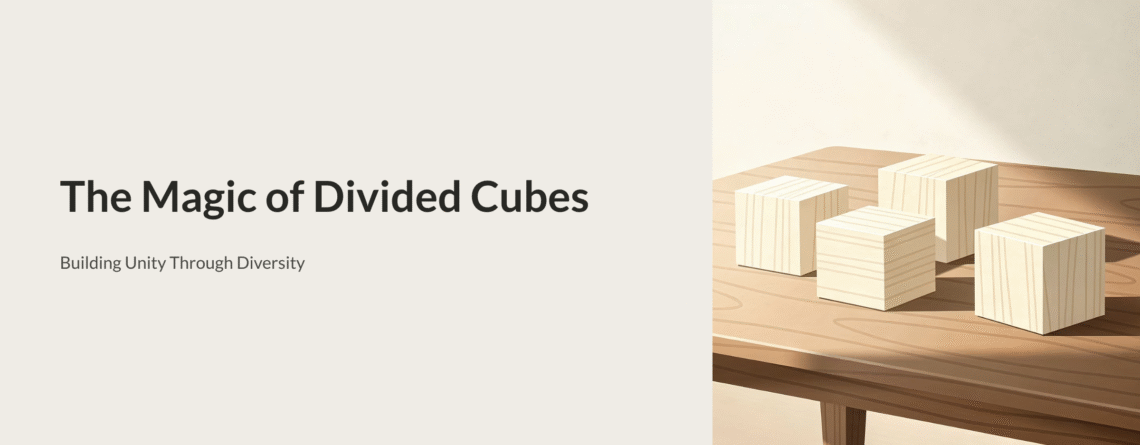
The Magic of Divided Cubes: Building Unity Through Diversity
Your child pulls apart a tower of blocks and scatters them across the floor.
Your first instinct: “Why do you always destroy things?”
Fröbel’s response, 180 years ago: “That’s not destruction. That’s the beginning of creation.”
He was right. Children don’t tear things apart because they’re careless. They tear things apart because they desperately want to know what’s inside. What something is made of. How the pieces relate to the whole. It’s one of the deepest learning instincts a child has—and most of the time, we accidentally punish them for it.
Fröbel didn’t punish it. He designed an entire set of educational tools around it.
Welcome to Gifts 3 through 6: the Divided Cubes. These are the building blocks that made Fröbel famous—and once you understand the philosophy behind them, you’ll never look at a box of blocks the same way again.
The Box Is the Lesson
Before your child touches a single block, the lesson has already begun. Because every set of Divided Cubes arrives the same way: as a solid wooden cube, resting perfectly inside a lidded box.
This isn’t packaging. It’s philosophy.
Unity: When the lid is on, the blocks form one solid cube—a symbol of what Fröbel called the “Great Whole.” Everything is contained. Everything belongs. Nothing is missing.
Diversity: When the child lifts the lid, that unity dissolves into many separate pieces. Eight small cubes. Or eight rectangular bricks. Or twenty-one triangular prisms.
Each one distinct. Each one capable of becoming something entirely new.
This is Fröbel’s core teaching: the whole can become many, and the many can return to the whole. Every play session begins with opening the box—moving from unity to diversity. And every play session ends with reassembling the cube and returning the blocks to the box—moving from diversity back to unity.
That closing ritual isn’t tidying up. It’s the lesson completing itself. Your child learns, physically and repeatedly, that no matter how many different things they create, all the pieces still belong together. Diversity returns to unity. Always.
For your homeschool, this is worth protecting. Resist the temptation to let blocks from different Gifts get jumbled together in a big bin. Each Gift is its own contained world. The box matters.
Turning Destruction Into Creation
Here’s why Fröbel was a genius about children’s so-called “destructive instinct.”
He didn’t try to suppress it. He redirected it.
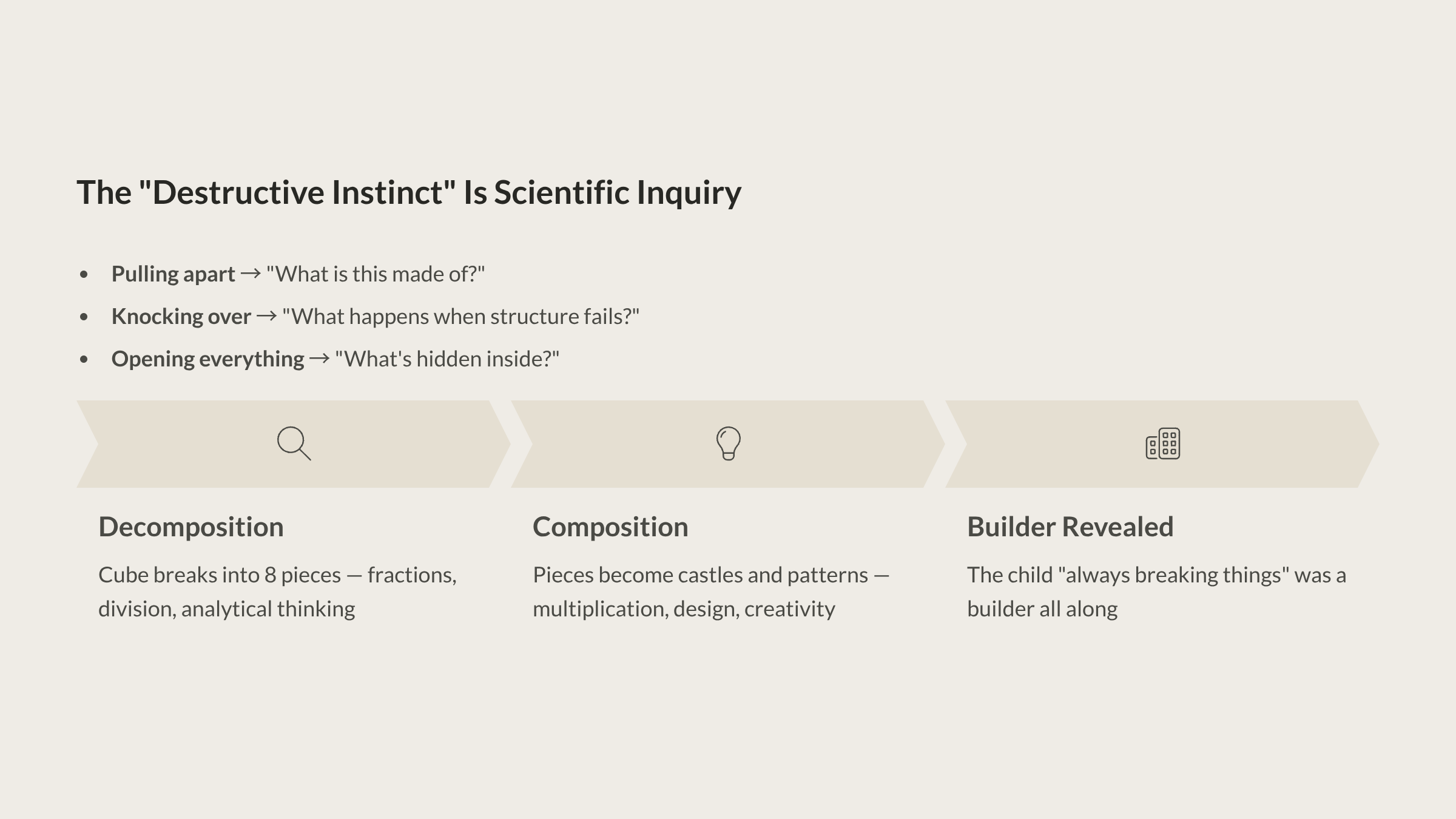
A child who pulls apart a puzzle is asking: “What is this made of?” A child who knocks over a tower is asking: “What happens when the structure fails?” A child who opens every drawer in the kitchen is asking: “What’s hidden inside?”
These are scientific questions. They’re engineering questions. They’re philosophical questions. And the Divided Cubes give children a safe, structured way to explore all of them.
When your child opens the box and the solid cube breaks into eight pieces, they’ve just experienced decomposition—the same principle that underpins fractions, division, and analytical thinking. When they rearrange those eight pieces into a castle, a bridge, or a symmetrical pattern, they’ve experienced composition—the same principle that underpins multiplication, design, and creative problem-solving.
Destruction becomes analysis. Analysis becomes creation. And the child who was “always breaking things” turns out to be a builder all along.
The Three Forms: How Children Play With Blocks
Fröbel didn’t just hand children blocks and say “go play.” He observed hundreds of children and identified three distinct types of building that emerge naturally. He called them Forms of Life, Forms of Knowledge, and Forms of Beauty.
Understanding these three forms will transform how you observe and guide your child’s block play.
Forms of Life — The Practical Builder
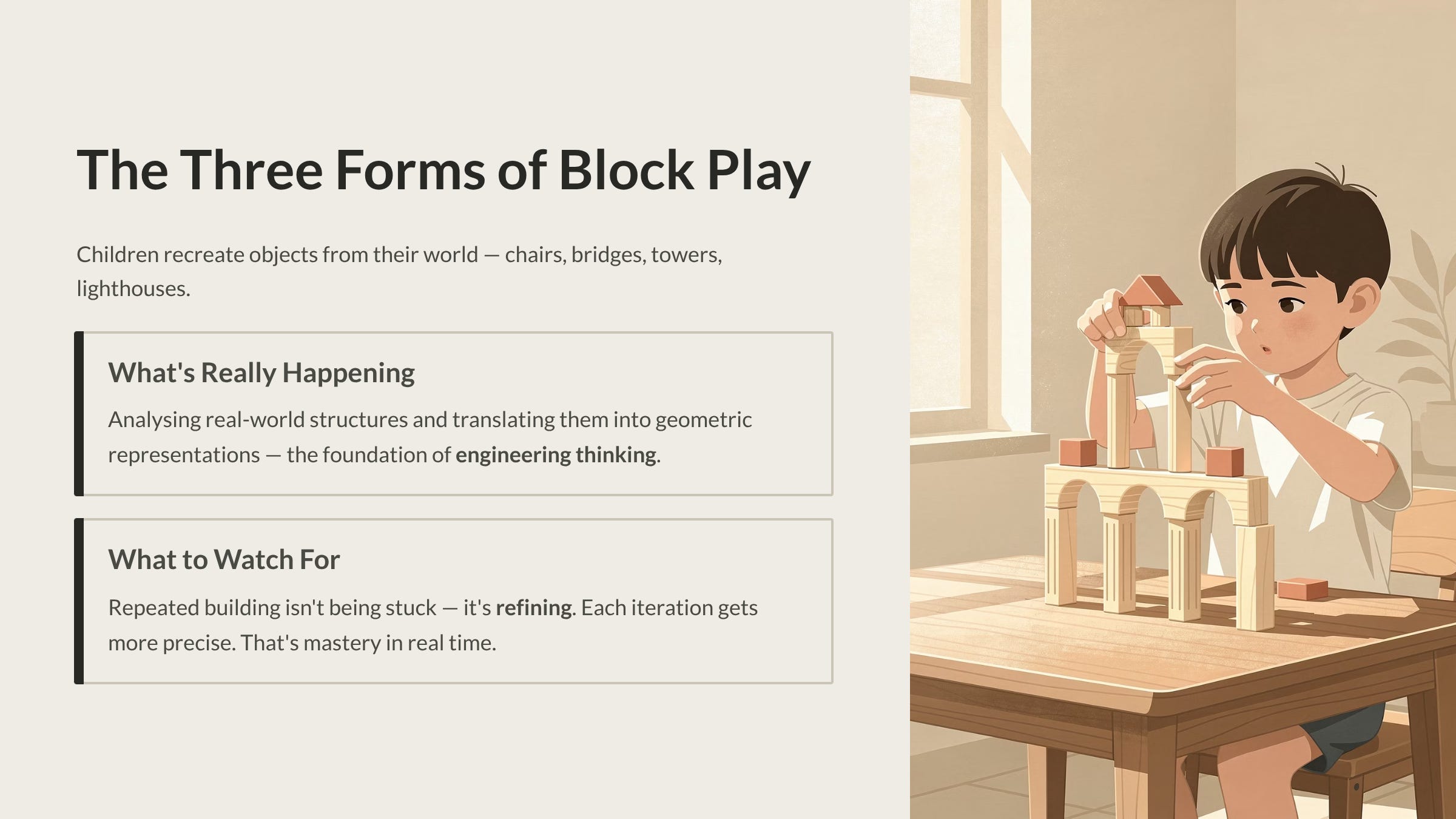
This is what most parents recognise as “normal” block play. The child uses blocks to recreate objects from their own world or imagination.
With Gift 3’s eight small cubes, a young child might build a simple chair, a table, or a castle. As they progress to Gift 4’s rectangular bricks, the buildings become more ambitious—bridges with arches, houses with rooms, towers with steps. By the time they reach Gift 5’s triangular prisms and Gift 6’s squares and columns, they’re constructing lighthouses, stadium entrances, and elaborate architectural projects that would impress most adults.
What’s really happening: Your child is learning to observe the world closely. To build a chair from blocks, they first have to notice what makes a chair a chair—four legs, a seat, a back. They’re analysing real-world structures and translating them into geometric representations. That’s the foundation of engineering thinking, statics, and architecture.
What to watch for: A child who builds the same structure repeatedly isn’t stuck—they’re refining. Each iteration gets a little more precise, a little more detailed. That’s mastery developing in real time.
Forms of Knowledge — The Mathematical Explorer
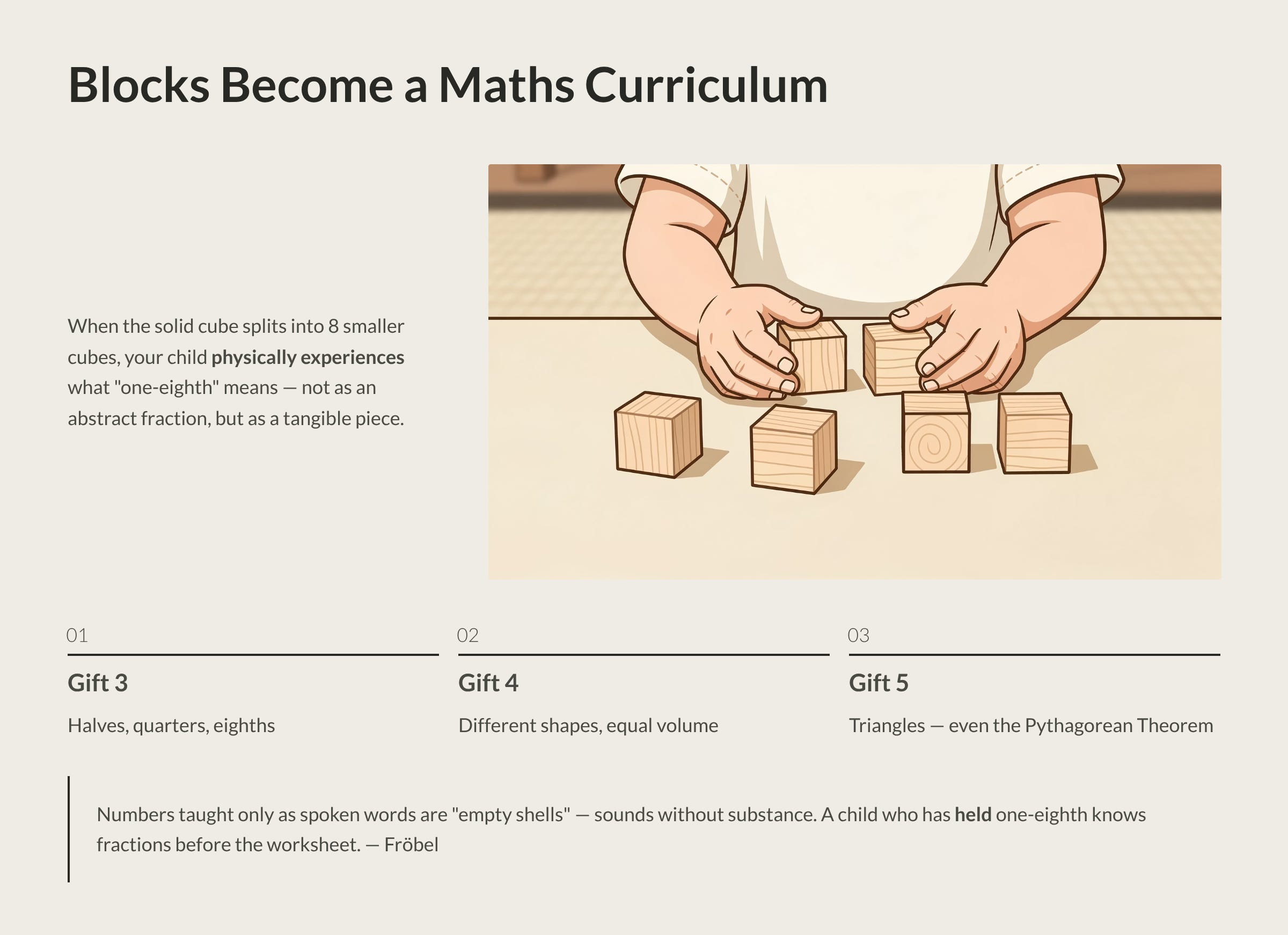
This is where blocks become a maths curriculum without your child realising it.
When the solid cube splits into eight smaller cubes, your child has just physically experienced what “one-eighth” means. Not as an abstract fraction on a worksheet—as a tangible piece they can hold, count, and compare to the whole.
Gift 3’s eight cubes teach halves, quarters, and eighths. Gift 4’s eight bricks introduce the concept of different shapes with equal volume—a brick is the same “amount” of wood as two cubes, just arranged differently. Gift 5’s twenty-one pieces allow children to explore triangles, and at advanced levels, even construct a visual demonstration of the Pythagorean Theorem.
What’s really happening: Your child is building a concrete understanding of number relationships that goes far beyond memorised facts. Fröbel argued that numbers taught only as spoken words are “empty shells”—sounds without substance. But a child who has held one-eighth of a cube in their hand, counted out four of them to make a half, and reassembled all eight into a whole? That child knows fractions. The worksheet later is just giving names to things they already understand.
What to watch for: Listen for your child counting spontaneously during play. “I used four blocks on this side and four on that side—that’s the same!” That’s mathematical reasoning emerging naturally. Don’t interrupt it with formal instruction. Just notice it, and later you can connect it to the proper terms.
Forms of Beauty — The Pattern Artist
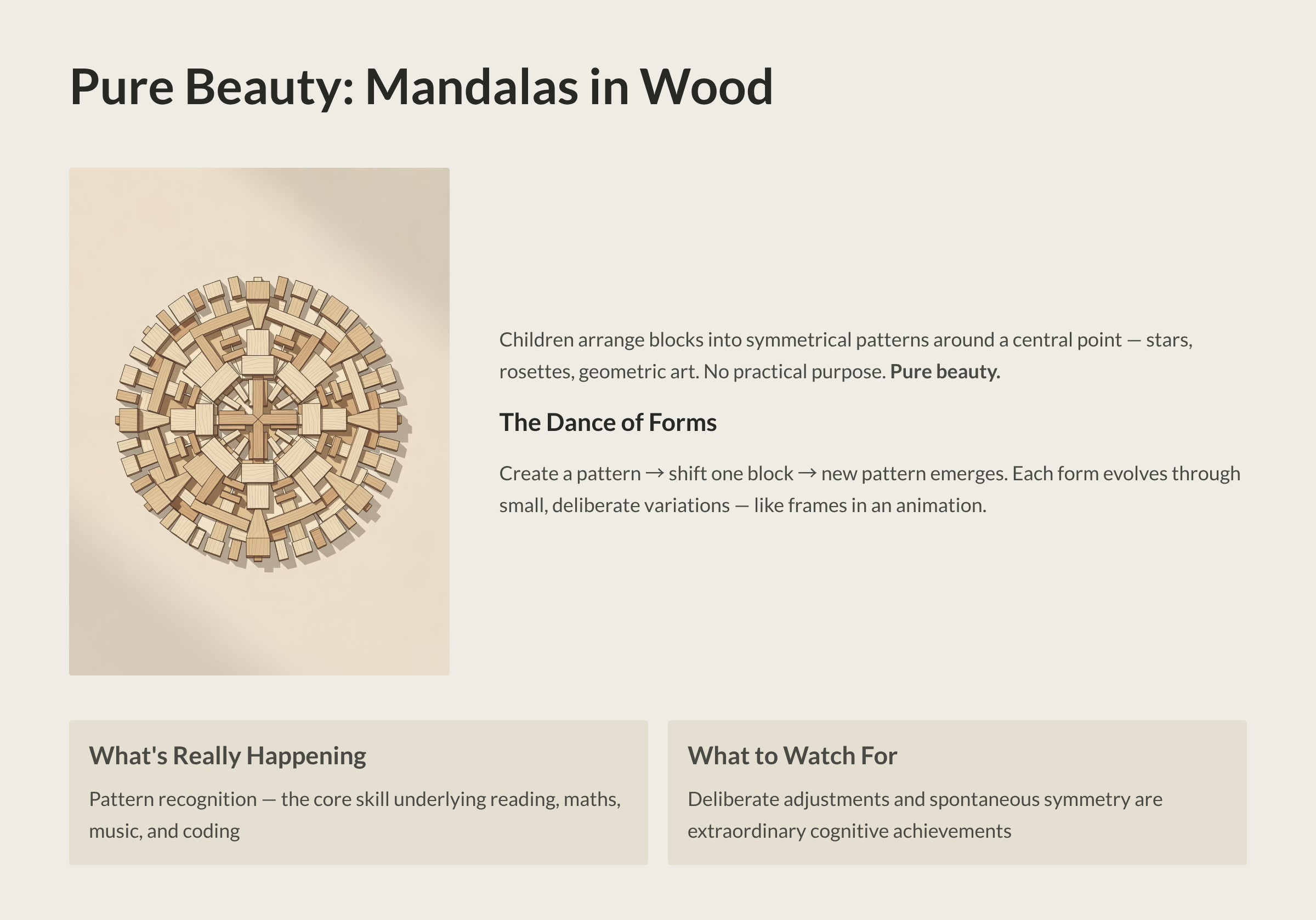
This is the form most adults have never seen, and it’s breathtaking.
The child arranges blocks into symmetrical, aesthetic patterns around a central point—creating what look like mandalas, stars, rosettes, and geometric art. No representational goal. No practical purpose. Pure beauty.
Fröbel’s favourite activity within this form was the “Dance of the Forms of Beauty.” The child creates one symmetrical pattern, then modifies it by shifting or rotating just one or two blocks to create a new pattern. Then another. Then another. Each new form evolves from the last through small, deliberate variations—like frames in an animation.
What’s really happening: Pattern recognition. This is one of the core elements of human intelligence—the ability to detect regularity, predict what comes next, and create variations within a system of rules. It’s the same skill that underlies reading, mathematics, music, and coding. And your child is developing it by making beautiful things with wooden blocks.
What to watch for: When your child creates a pattern and then deliberately adjusts one piece to see how the whole design changes, they’re thinking systematically. When they create a pattern that’s symmetrical without being told to, they’ve internalised a principle of aesthetic order. Both of these are extraordinary cognitive achievements, and they look like “just playing.”
A Growing Challenge: From Gift 3 to Gift 6
Fröbel followed one consistent principle across the entire Gift sequence: from the easy to the difficult. Each Gift builds on the skills developed by the one before it.
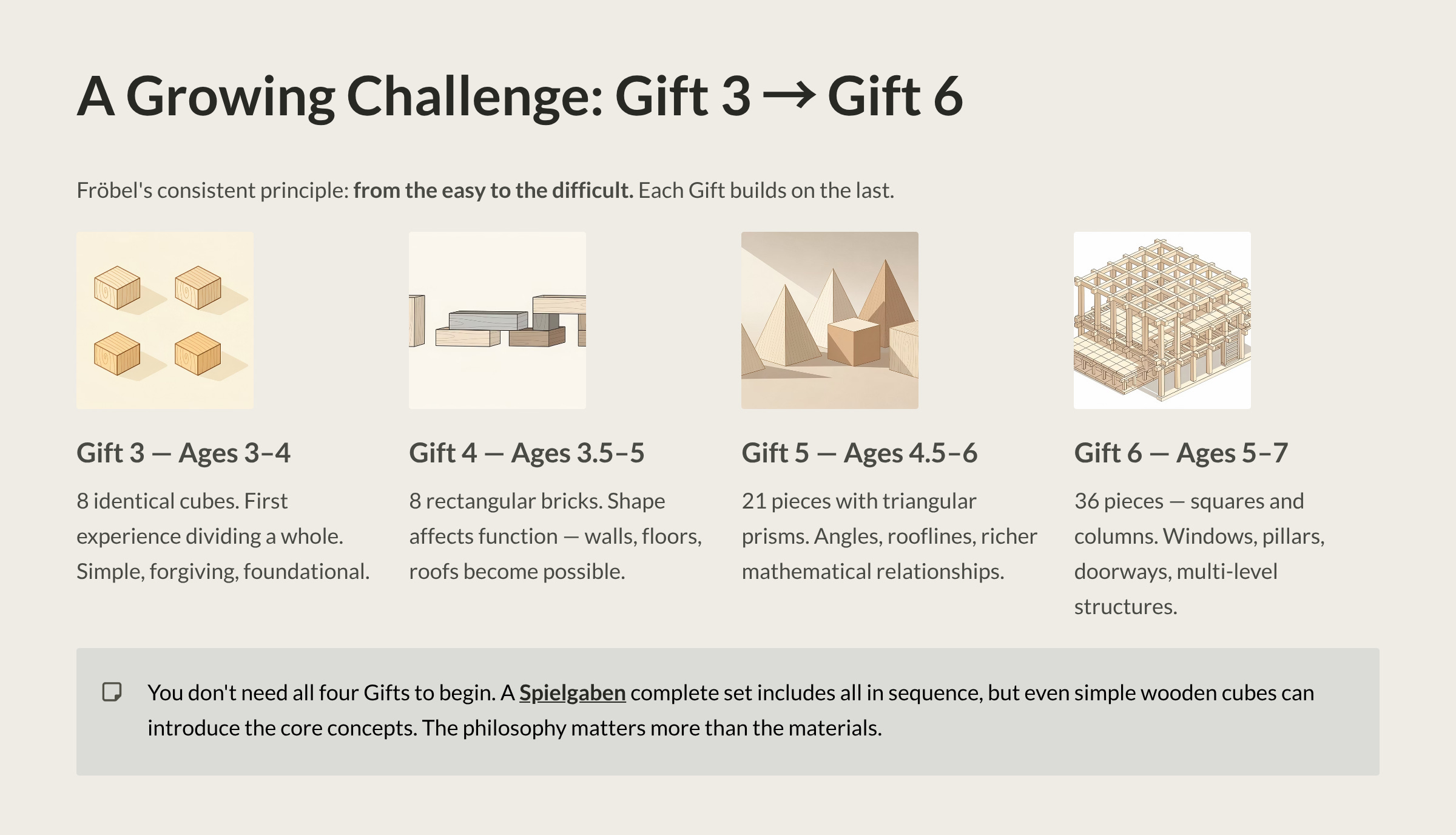
Gift 3: The Divided Cube (8 small cubes)
Your child’s first experience of dividing a whole into parts. Eight identical cubes—simple, symmetrical, forgiving. If a structure falls, it’s easy to rebuild. If a pattern doesn’t work, there are only eight pieces to rearrange.
Best for: Ages 3–4 as an introduction to building, though younger toddlers can explore freely. Teaches basic spatial relationships, counting to eight, and the concept of parts making a whole.
Gift 4: The Divided Cube (8 rectangular bricks)
Same number of pieces, but now the shape has changed. The bricks are longer and flatter than cubes, which introduces new building possibilities and new challenges. Walls become possible. Floors and roofs become possible. The child learns that shape affects function—a brick can do things a cube cannot.
Best for: Ages 3.5–5. Builds on Gift 3 by introducing rectangular forms, which require more precise placement and develop finer motor control.
Gift 5: The Divided Cube (21 pieces including triangular prisms)
A significant leap in complexity. The box now contains cubes, half-cubes, and quarter-cubes cut diagonally—creating triangular prisms. Suddenly, angles appear. Rooflines are possible. Pointed structures emerge. And the mathematical relationships become richer: a child can see that two triangular prisms make a cube, and four quarter-cubes make a whole.
Best for: Ages 4.5–6. Requires higher levels of fine motor skill, patience, and spatial reasoning. This is where children who have worked through Gifts 3 and 4 begin to surprise you with the sophistication of their constructions.
Gift 6: The Divided Cube (36 pieces including squares and columns)
The most complex of the Divided Cubes. Thin flat squares and narrow rectangular columns allow for detailed architectural work—windows, pillars, doorways, multi-level structures. The child is now working with a genuine construction vocabulary of shapes.
Best for: Ages 5–7. At this stage, children can plan structures before building them, troubleshoot when things don’t balance, and create designs that are both structurally sound and aesthetically pleasing.
A note for parents: You don’t need to own all four Gifts to begin. A Spielgaben complete set includes all of them in the proper sequence, but if you’re starting with what you have, even a set of simple wooden cube blocks can introduce the core concepts of Forms of Life, Knowledge, and Beauty. The philosophy matters more than the specific materials.
The Golden Rule: Use Every Block
There is one rule in Fröbelian block play that changes everything, and it’s the rule most parents and teachers overlook:
Every block in the box must be used in the creation. Nothing is “superfluous.”
This sounds restrictive. It’s actually liberating—and deeply educational.
When your child can set aside blocks they don’t want, building is easy. They grab the pieces that fit their vision and ignore the rest. But when every piece must be incorporated, something remarkable happens: they have to think holistically. They can’t just build a tower and leave six blocks sitting on the table. Those six blocks need to become part of the design—a foundation, a garden wall, a path, a decorative element.
This forces creative problem-solving. It teaches the child that every part has value. And it reinforces Fröbel’s deepest conviction: that the diversity of creation is always a reflection of the original whole. Nothing is wasted. Everything belongs.
If you implement only one Fröbelian rule in your homeschool block play, make it this one. It will transform how your child thinks about building—and about solving problems in general.
Bringing the Divided Cubes Into Your Homeschool
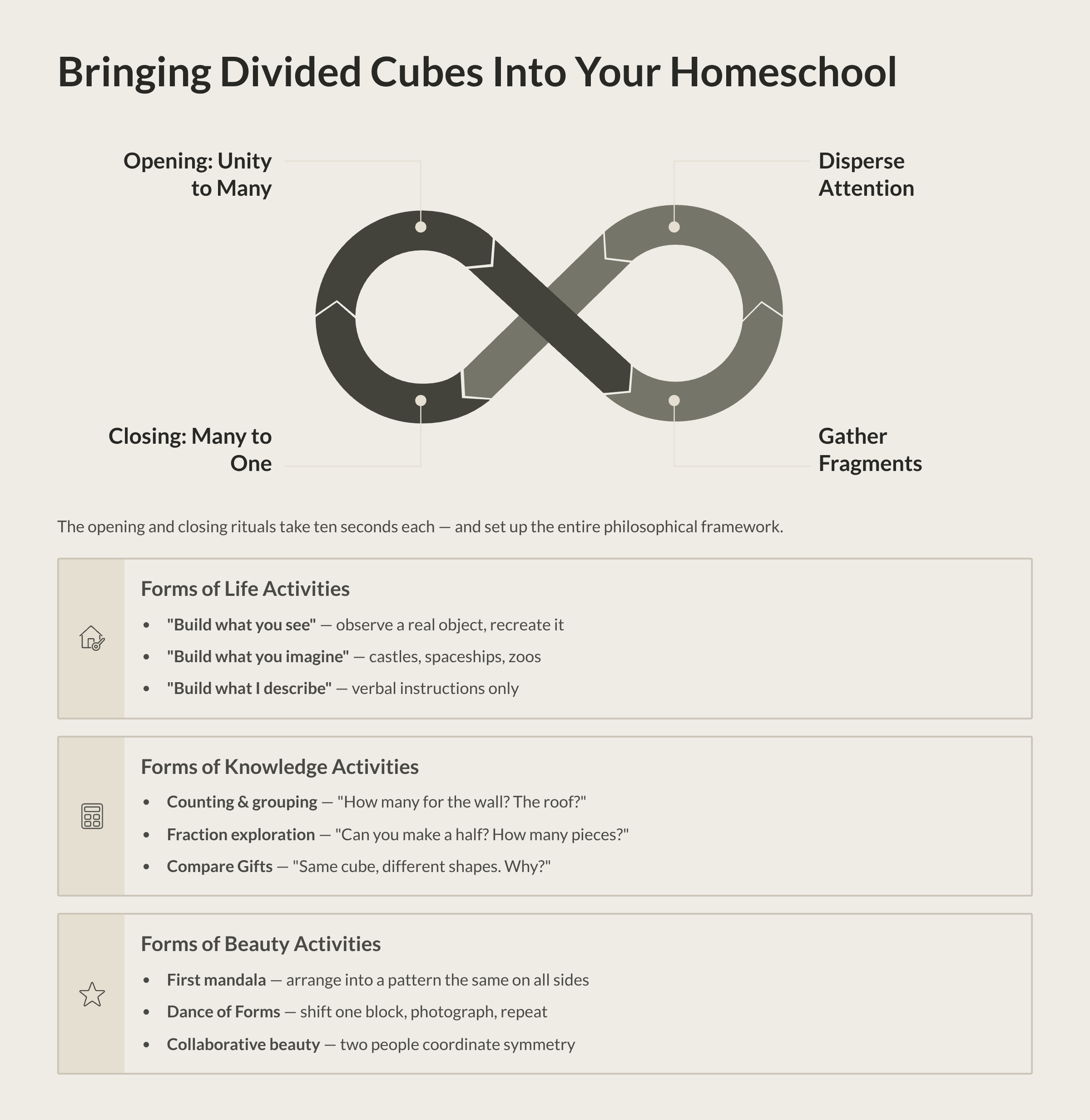
Here’s how to use Gifts 3–6 intentionally across the three Forms.
Getting Started (Any Age)
The opening ritual. Before your child begins building, have them look at the closed box. “What’s inside? One solid cube.” Lift the lid together. “Now it’s eight pieces. The one became many.” This takes ten seconds and sets up the entire philosophical framework.
The closing ritual. When play is finished, reassemble the cube together. “The many become one again.” This is non-negotiable in Fröbelian practice—and children come to love it. It gives closure and a sense of completeness to every session.
Forms of Life Activities
- “Build what you see.” Ask your child to look around the room and build something they can see—a chair, a table, a bookshelf. This develops observational skills and the ability to translate 3D objects into geometric representations.
- “Build what you imagine.” Let your child build from pure imagination—a castle, a spaceship, a zoo. This develops creative thinking and narrative skills.
- “Build what I describe.” Describe a structure verbally and have your child build it from your words alone: “It has a wide base, two tall pillars, and a flat bridge across the top.” This develops listening comprehension and spatial reasoning from verbal instructions.
Forms of Knowledge Activities
- Counting and grouping. “How many blocks did you use for the wall? How many for the roof? How many altogether?” This introduces addition in context.
- Fraction exploration. Hold up the complete cube, then open it. “This cube is the whole. Each small cube is one-eighth. Can you make a half? How many pieces do you need?” This is fractions made tangible.
- Comparison of Gifts. Once your child has access to both Gift 3 and Gift 4, ask: “Both boxes make the same size cube. But the pieces are different shapes. Why?” This introduces the concept of equal volume with different dimensions—a powerful mathematical idea.
Forms of Beauty Activities
- First mandala. Start with all blocks in the centre of the table. Ask your child to arrange them into a pattern that looks the same on all sides. Don’t give them a model—let them discover symmetry through experimentation.
- The Dance of Forms. Once your child has created a symmetrical pattern, ask them to move just one block to create a new pattern. Then one more. Then one more. Photograph each step. At the end, scroll through the photos together and watch the pattern “dance.”
- Collaborative beauty. Two children (or parent and child) sit on opposite sides and each take responsibility for their half of the pattern. They must communicate and coordinate to keep it symmetrical. This is Head, Heart, and Hand working together.
What You’ll See Change
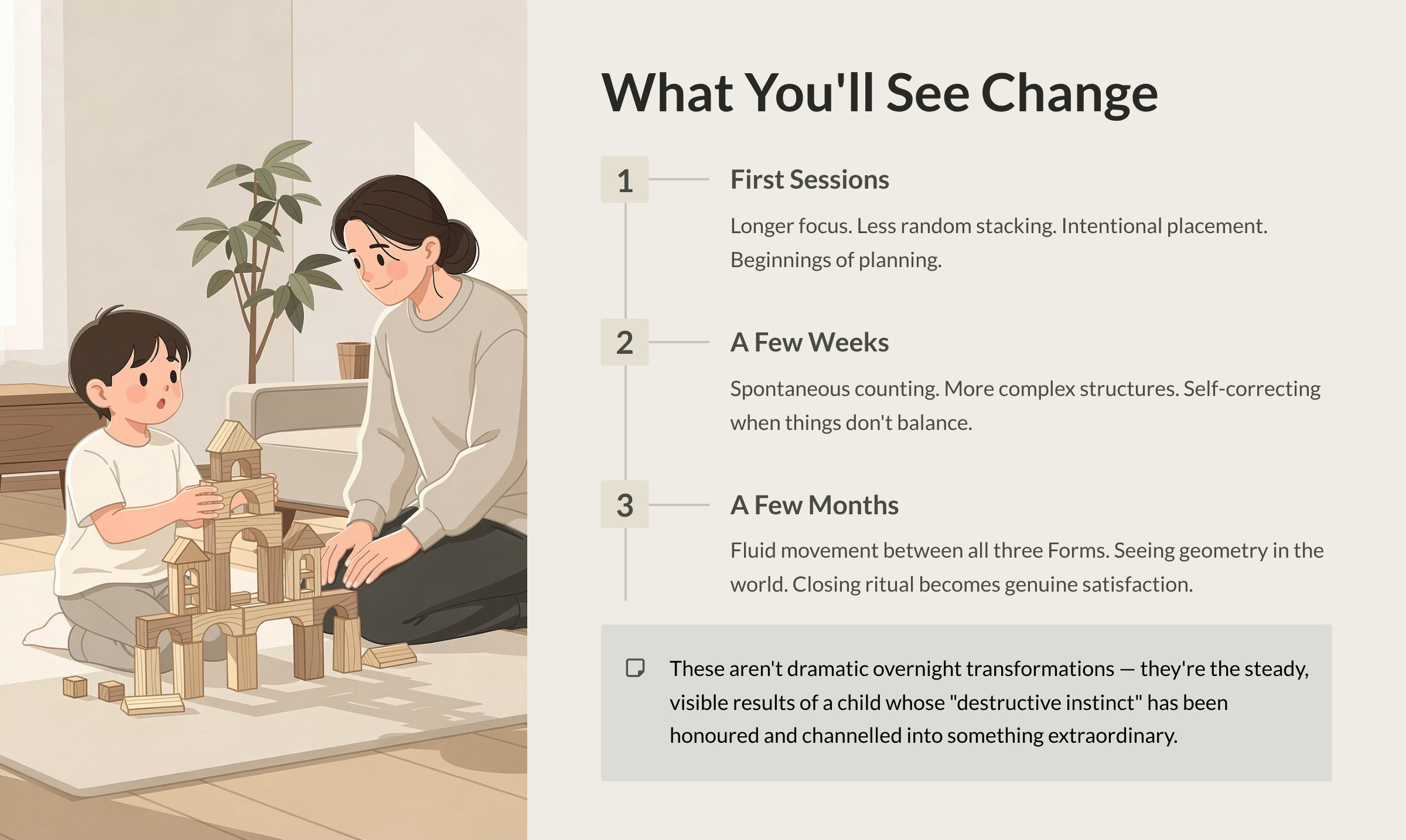
Parents who introduce the Divided Cubes intentionally—with the opening and closing rituals, the golden rule of using every block, and awareness of the three Forms—consistently report the same changes in their children:
Within the first few sessions: Longer sustained focus during block play. Less random stacking, more intentional placement. The beginnings of planning before building.
Within a few weeks: Spontaneous counting and comparison during play. More complex structures. The child begins self-correcting when something doesn’t balance rather than abandoning the project.
Within a few months: The child moves fluidly between Forms of Life, Knowledge, and Beauty—sometimes within a single session. They start seeing geometric relationships in the world around them. And the closing ritual—reassembling the cube—becomes a moment of genuine satisfaction rather than a chore.
These aren’t dramatic overnight transformations. They’re the steady, visible results of a child whose “destructive instinct” has been honoured and channelled into something extraordinary.
Coming Next Week
We’ve spent the last several weeks deep inside the three-dimensional world of Fröbel’s Gifts—from the soft ball, through the solid shapes, to the divided cubes.
Next, we shift dimensions. We’re moving from blocks to flat surfaces, from building to composing, from three dimensions to two.
We’re beginning our exploration of Fröbel’s “Occupations,” starting with the art of Parquetry and Patterns—where geometric tiles become tools for design, symmetry, and the foundations of visual mathematics.
If your child loves puzzles, mosaics, or arranging things “just so,” next week’s post was made for them.
This is part of our ongoing Fröbel Gifts Masterclass at the Spielgaben Homeschool Series. If you’re new here, start with our earlier posts on Fröbel’s life story, the Law of Opposites, and Holistic Education: Head, Heart, and Hand and The First Gift: The Ball and The Second Gift: Sphere, Cylinder, and Cube.
Subscribe here to follow the complete Masterclass series and give your child the gift of purposeful play.




LEAVE A COMMENT