
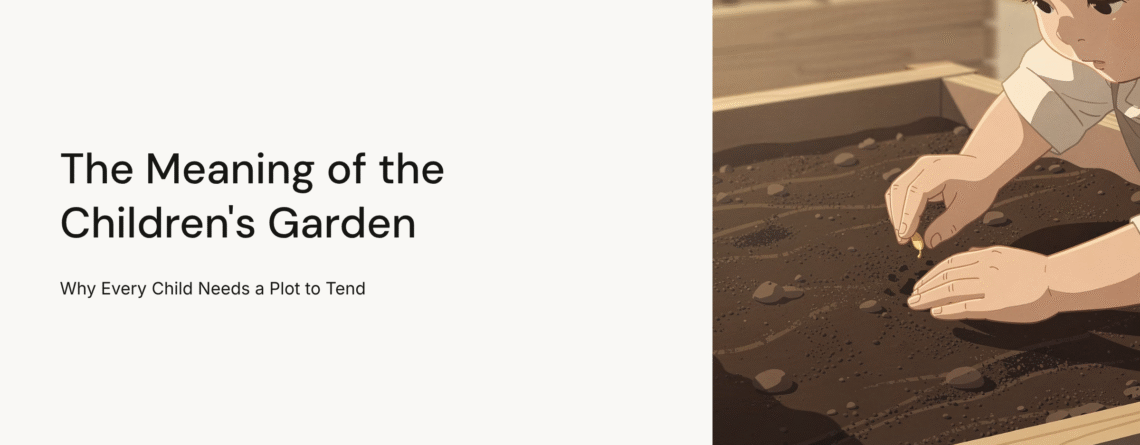
The Meaning of the Children’s Garden: Why Every Child Needs a Plot to Tend
Give a child a seed and a small pot of soil. Tell them it’s theirs. Walk away.
Come back in ten minutes and they’ll have their fingers in the dirt. Come back in a week and they’ll be checking on their pot before breakfast. Come back in a month—when a green shoot breaks through—and you’ll see something on their face that no worksheet, no lesson plan, no screen has ever produced.
Ownership. Responsibility. Wonder.
That’s not a gardening project. That’s education at its deepest level. And Friedrich Fröbel knew it two centuries ago—which is exactly why he didn’t call his invention a “children’s school” or a “children’s classroom.”
He called it a kindergarten. A children’s garden.
That word wasn’t a metaphor. It was a blueprint.
Today, we step outside. After weeks of exploring the indoor world of Gifts and Occupations—from the soft ball to divided cubes, from Parquetry tiles to paper folding to stick and pea constructions—we return to the element that Fröbel considered foundational to everything: nature itself.
And his message for homeschool parents is startlingly specific: every child should have their own small plot to tend. Not a family garden they help with. Not a school project they participate in. Their own piece of earth, however small.
Here’s why—and how to make it work, whether you have a sprawling backyard or a single windowsill.
A Boy in a Walled Garden: Where It All Began
To understand why Fröbel placed the garden at the centre of his educational vision, we have to understand his childhood.
As we explored in our very first post about Fröbel’s life, his early years were marked by deep loneliness. His mother died before he turned one. His stepmother withdrew her affection. His father, a busy pastor, had little time for the boy.
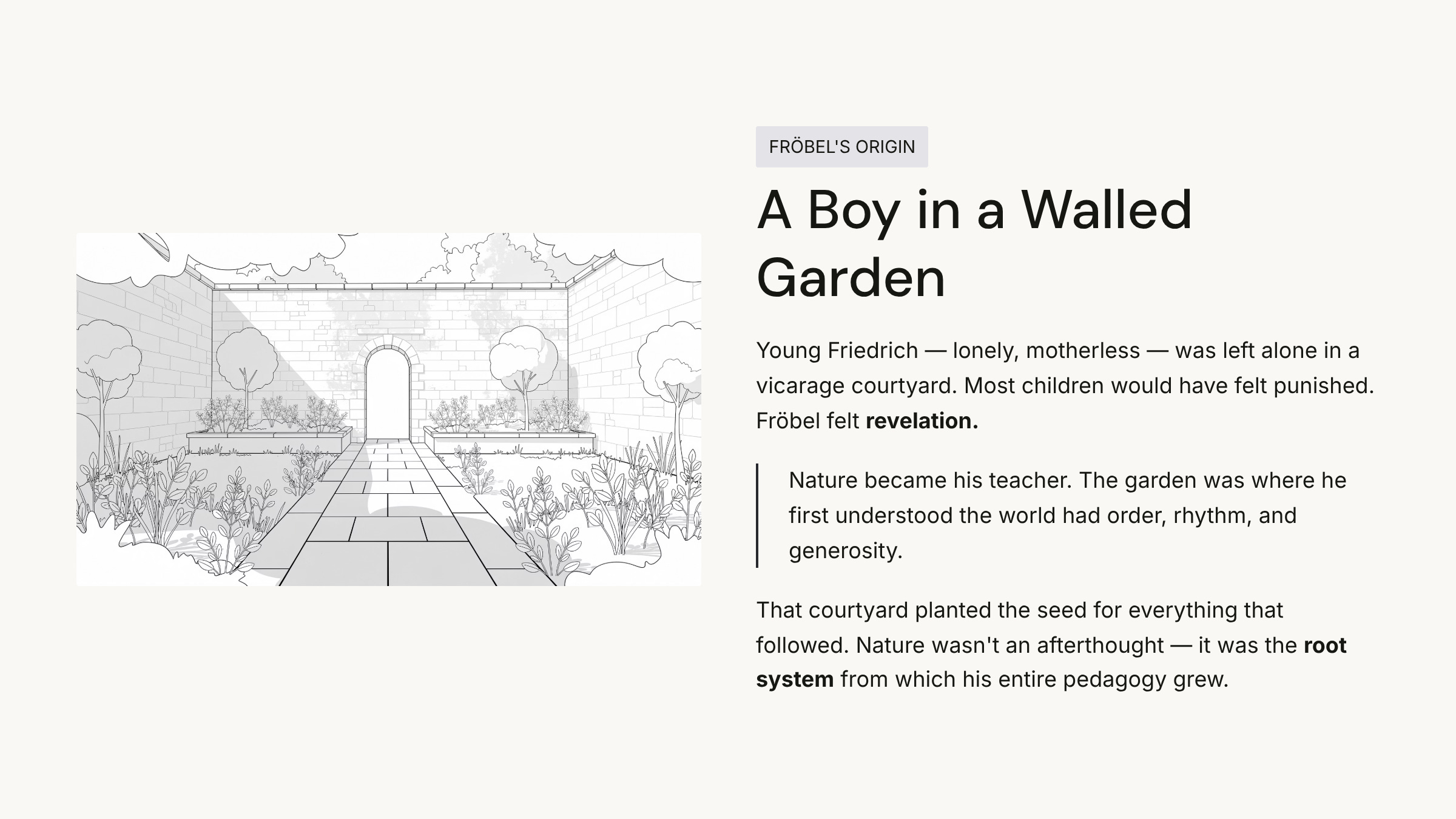
Young Friedrich was often locked in the vicarage courtyard—left alone behind high walls with nothing but the garden for company. Most children would have experienced this as punishment. Fröbel experienced it as revelation.
Nature became his teacher. He helped his father tend plants. He watched seeds germinate, shoots push through soil, flowers open toward light. He began to see the natural world as a living expression of something larger—a “revelation of God’s deeds,” as he later wrote. The garden wasn’t just a pleasant place. It was where he first understood that the world had an order, a rhythm, and a generosity that could be trusted.
That lonely courtyard planted the seed—quite literally—for everything that followed. When Fröbel grew up to design his system of education, nature wasn’t an afterthought bolted onto indoor activities. It was the root system from which everything else grew. The wooden Gifts echo natural forms. The Occupations follow natural laws. And the garden itself—the literal garden—was where children learned the most important lessons of all.
A child who cares for another living thing, Fröbel believed, will be more easily led to care for and foster their own life. That conviction shaped his entire pedagogy.
Why “Their Own” Plot Matters
Fröbel’s ideal kindergarten layout was precise. It included a common garden—a demonstration bed maintained by the teacher—and surrounding it, small individual plots, one for each child.
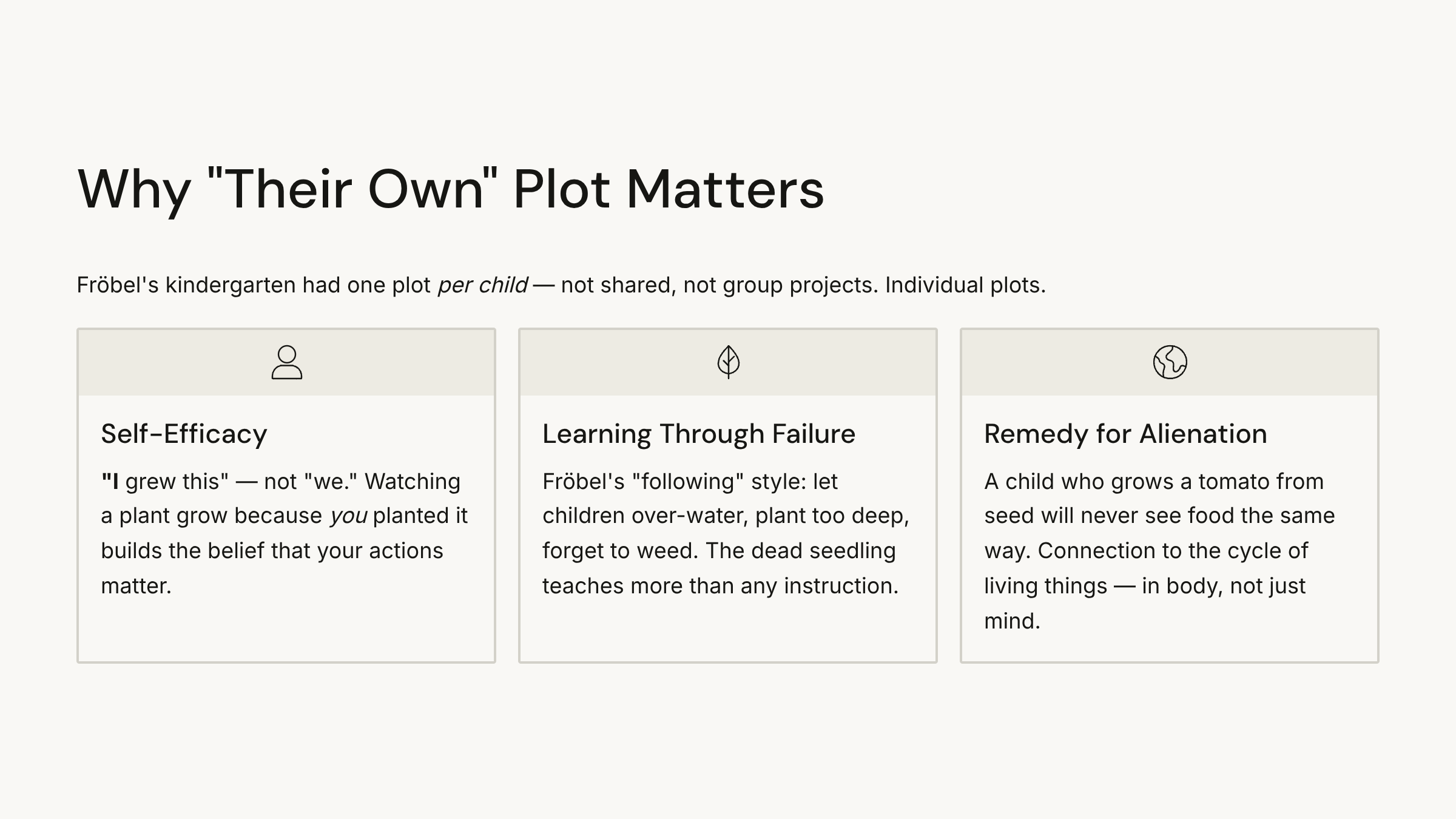
Not shared plots. Not group projects. Individual plots.
This distinction is easy to overlook and crucial to understand. Here’s what happens when a child has a garden bed that belongs exclusively to them.
Self-Efficacy: “I Made This Happen”
On their own plot, children choose what to plant. They decide where each seed goes. They water it—or forget to, and face the consequences. And when the first green shoot appears, the feeling isn’t “we grew something.” It’s “I grew something.”
That shift from “we” to “I” is self-efficacy—the belief that your actions matter, that you can make things happen in the world. It’s one of the most important psychological foundations a child can develop, and few experiences build it as directly as watching a plant grow because you put the seed in the ground, you watered it, and you didn’t give up during the days when nothing seemed to be happening.
For homeschool families, this is especially valuable. The individual plot gives your child a domain of genuine autonomy within your shared learning environment. It’s theirs. Not yours that they help with. Theirs.
Learning Through Failure: The “Following” Style
Here’s something that might make you uncomfortable: Fröbel believed children should be allowed to handle plants incorrectly.
Over-water them. Plant seeds too deep. Forget to weed. Pull a seedling up to “check if it’s growing.” Put a shade-loving plant in full sun.
He didn’t want adults to prevent these mistakes. He wanted children to discover the consequences for themselves.
This is what Fröbel called his “following” educational style—following the child’s actions and allowing natural consequences to teach the lesson. It’s the gardening equivalent of letting your child’s stick-and-pea structure collapse so they learn about triangulation. The dead seedling teaches more about plant care than any amount of instruction ever could.
Your role as the parent-gardener: Maintain your own demonstration bed alongside your child’s plot. Garden well. Let your child observe the contrast between your thriving plants and their struggling ones. When they ask “why are yours bigger?”—and they will—you have a teaching moment that they initiated, which means they’re ready to learn.
Don’t rescue their plot. Don’t sneak out at night to water it. Let the garden teach what the garden teaches. Your child’s resilience grows alongside whatever survives.
A Remedy for Alienation
Fröbel could not have predicted supermarkets. But he would have understood the problem immediately.
When a child’s only experience of food is picking it off a shelf—washed, packaged, identical, and disconnected from every process that created it—something essential is lost. The child doesn’t understand where food comes from. They don’t understand that it takes time, effort, and cooperation with natural forces. They don’t understand their own place in the cycle of living things.
A garden plot—even a tiny one—reverses this. A child who has grown a tomato from seed, waited weeks for it to ripen, picked it warm from the vine, and eaten it at the kitchen table will never again see a tomato the same way. They understand, in their body and not just their mind, that food comes from the earth, requires care, and connects them to something larger than themselves.
In a world of increasing screen time and decreasing nature contact, this isn’t nostalgia. It’s a necessary correction.
The Cycle of Life Unity: What the Garden Teaches That Nothing Else Can
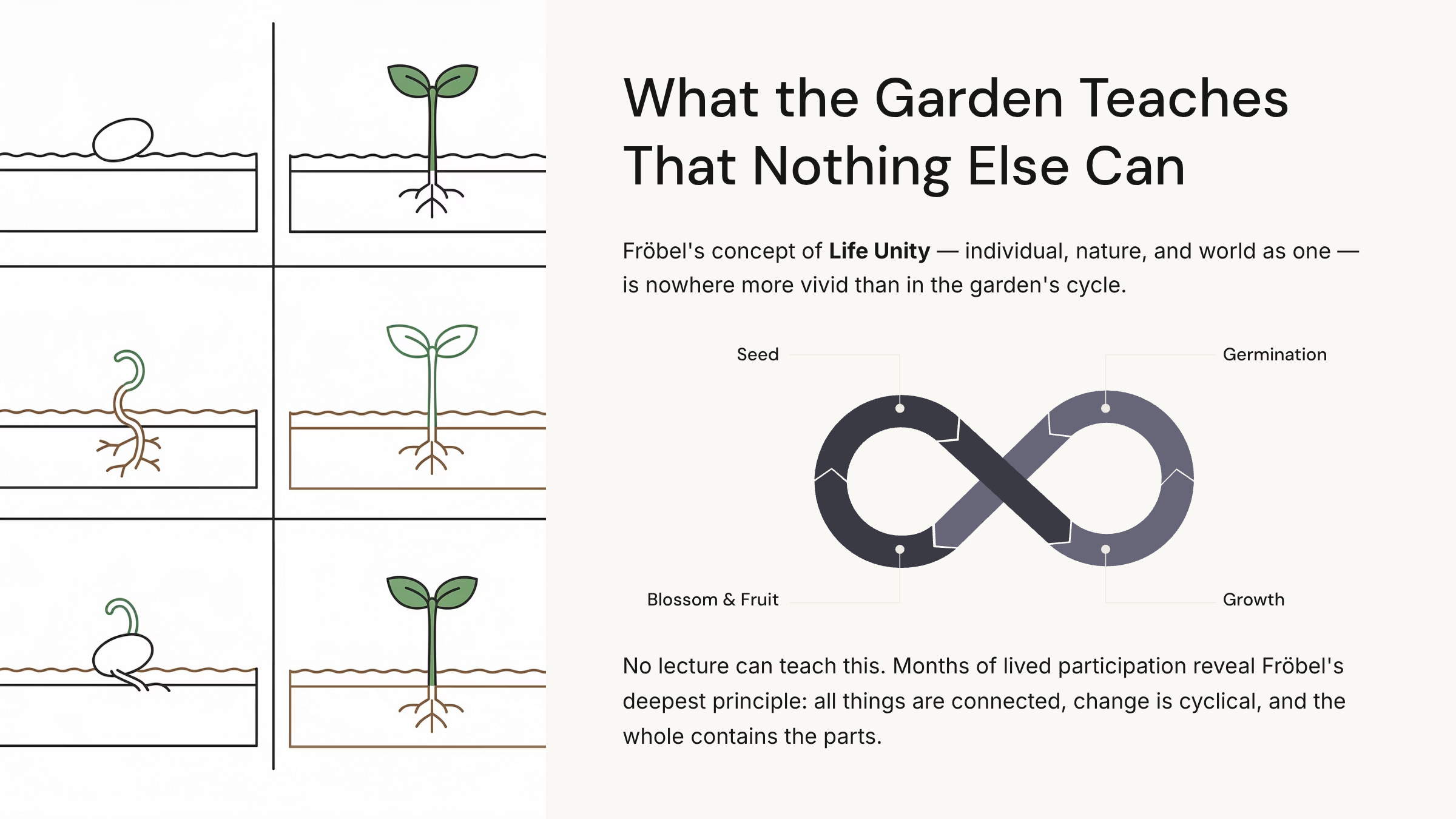
Fröbel’s concept of “Life Unity”—the recognition that the individual, nature, and the broader world are fundamentally connected—runs through every Gift and Occupation we’ve explored. But nowhere is it more vivid than in the garden.
Because the garden moves through time.
Blocks don’t grow. Tiles don’t change. Paper, once folded, stays folded. But a garden is alive. It develops. It transforms. And your child, tending it week after week, witnesses the entire cycle of living nature firsthand.
Seed to Harvest: The Full Arc
The seed. Small, dry, apparently lifeless. Your child holds it and has to take on faith that something is hidden inside. (Connect this to the Gift sequence: the potential inside the unopened box.)
The germination. Days of nothing. The soil sits there. Your child waters and waits. Patience isn’t being taught here—it’s being required. There’s no way to speed this up. No shortcut. No hack.
The shoot. One morning, a pale green curve breaks through the surface. Your child didn’t see it happen. It happened invisibly, underground, in the dark. Some of the most important processes in life are invisible—and the garden teaches children to trust that growth is happening even when they can’t see evidence.
The growth. Leaves unfurl. The stem thickens. The plant reaches toward the light. Your child watches something they planted respond to the same sun that warms their face. Connection. They’re part of the same system.
The blossom. Beauty that exists for a reason—to attract pollinators, to enable reproduction. Form and function united. The same principle that Fröbel embedded in every Gift.
The fruit. The payoff. Weeks—sometimes months—of effort, patience, and care, materialised into something tangible that your child can hold, eat, or share. No experience builds delayed gratification more effectively than growing food.
The seed again. And here’s where the cycle reveals its deepest lesson. Collect seeds from the harvest. Dry them. Store them. Plant them the following spring. The end was a new beginning. Diversity and change returned to unity—and the unity contains the potential for all future diversity.
Your child has just experienced, through months of lived participation, the philosophical principle that Fröbel spent his life articulating: that all things are connected, that change is part of a cycle, and that the whole contains the parts just as the parts create the whole.
No lecture can teach this. The garden can.
Bringing the Children’s Garden Into Your Homeschool
Here’s how to implement Fröbel’s garden philosophy at any scale.
The Essentials (Any Living Situation)
You need three things:
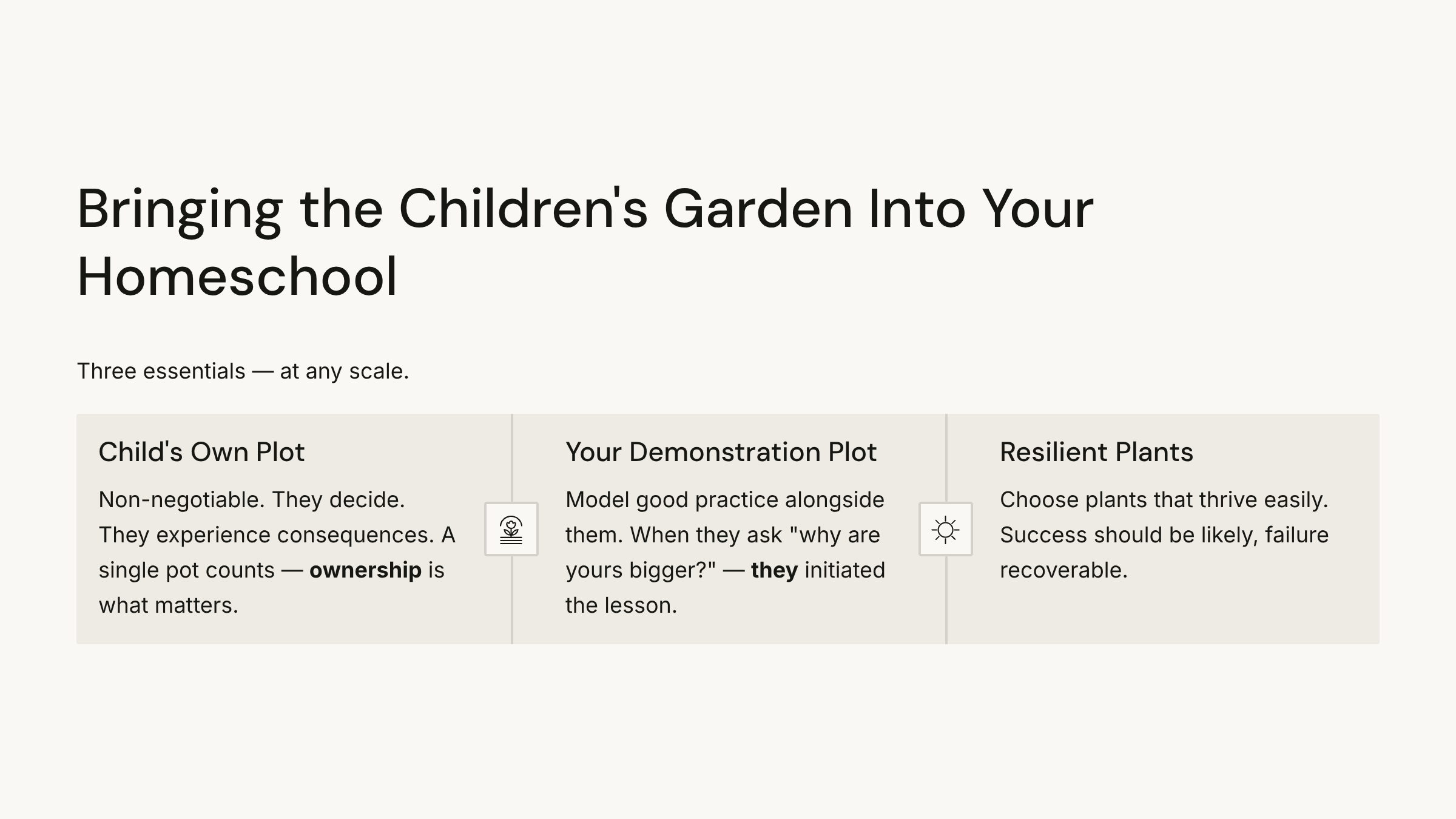
1. Your child’s own plot. This is non-negotiable in Fröbelian terms. The plot belongs to the child. They make decisions about it. They experience the consequences. The size doesn’t matter—a single pot counts. What matters is ownership.
2. Your demonstration plot. This is where you model good practice. Plant the same things your child plants, but garden well—water consistently, weed regularly, provide proper light. When your child sees the difference, curiosity drives the learning.
3. Common, resilient plants. Fröbel recommended choosing plants that thrive easily and produce abundantly. This isn’t the time for finicky orchids or temperamental herbs. You want success to be likely and failure to be recoverable. More on specific plants below.
If You Have a Backyard
Setting up the individual plot:
Allocate a small bed—even 60cm × 60cm is enough to start. Let your child help prepare it: turning soil, removing stones, adding compost. This physical preparation is itself educational—they’re learning that good results require ground-level work before anything visible happens.
Mark the boundaries clearly. A simple border of stones, sticks, or small timber makes the plot feel like a defined space that belongs to them. This matters psychologically. Boundaries create ownership.
What to plant (Australian-friendly suggestions):
- Sunflowers: Fast-growing, dramatic, deeply satisfying. A child who plants a sunflower seed and watches it grow taller than they are has an experience they’ll remember for decades. Plant in spring (September–November in Australia).
- Cherry tomatoes: Resilient, prolific, and children eat them straight off the vine. Plant seedlings after the last frost.
- Lettuce and spinach: Quick to germinate (7–14 days), which rewards impatient young gardeners. Can be planted in cooler months (March–May and August–October).
- Nasturtiums: Nearly indestructible, beautiful, and edible. Flowers add colour to salads—children love this. Direct sow in spring.
- Radishes: Germinate in days, harvest in weeks. The fastest “seed to plate” experience available. Great for demonstrating the full cycle quickly.
- Beans: Dramatic germination—children can watch the seed split and the root emerge. Grows fast, climbs enthusiastically, produces visibly. Plant in spring after soil warms.
Time commitment: 10–15 minutes daily for watering and observation. One longer session (30–45 minutes) weekly for weeding, feeding, and general care. Seasonal tasks (planting, harvesting, seed collecting) as they arise.
If You Have a Balcony or Patio
Everything above applies—just in containers.
Key adjustments:
- Use large pots (at least 30cm diameter) for tomatoes, beans, and sunflowers. Smaller pots work for lettuce, radishes, and herbs.
- Ensure adequate drainage—drill holes if your pots don’t have them.
- Balcony gardens dry out faster than ground beds. Your child will need to water more frequently, which actually increases their daily engagement with the plants.
- Position pots to maximise sunlight. Most vegetables need 6+ hours of direct sun.
Your child’s “plot” can be a single large pot or a group of smaller ones clustered together. The principle is the same: these are their plants. They decide, they tend, they experience the results.
If You Only Have a Windowsill
The garden still works. Fröbel himself recommended “boxes or flowerpots” when larger spaces weren’t available. The key is choosing the right plants.
Best for windowsills:
- Herbs: Basil, parsley, chives, and mint grow well in small pots indoors with adequate light. They’re fast, fragrant, and your child can use them in cooking—connecting their garden directly to family meals.
- Microgreens: Germinate in 2–3 days, ready to eat in 7–14 days. Grow in a shallow tray with a thin layer of soil. Sunflower, pea, and radish microgreens are easiest. This is the fastest seed-to-table experience possible.
- Bean sprouting: Not technically gardening, but the principle holds. Your child places beans on wet cotton wool, watches roots emerge within days, and gains a visceral understanding of germination that no picture in a book can match.
- Lettuce: Compact varieties grow surprisingly well in windowsill pots with 4+ hours of light.
Your child’s “plot” is their own pot or tray, clearly labelled with their name. Even this small gesture of ownership changes how they relate to the plants.
For All Settings: The Rhythm of the Garden
Regardless of scale, build a weekly rhythm around the garden:
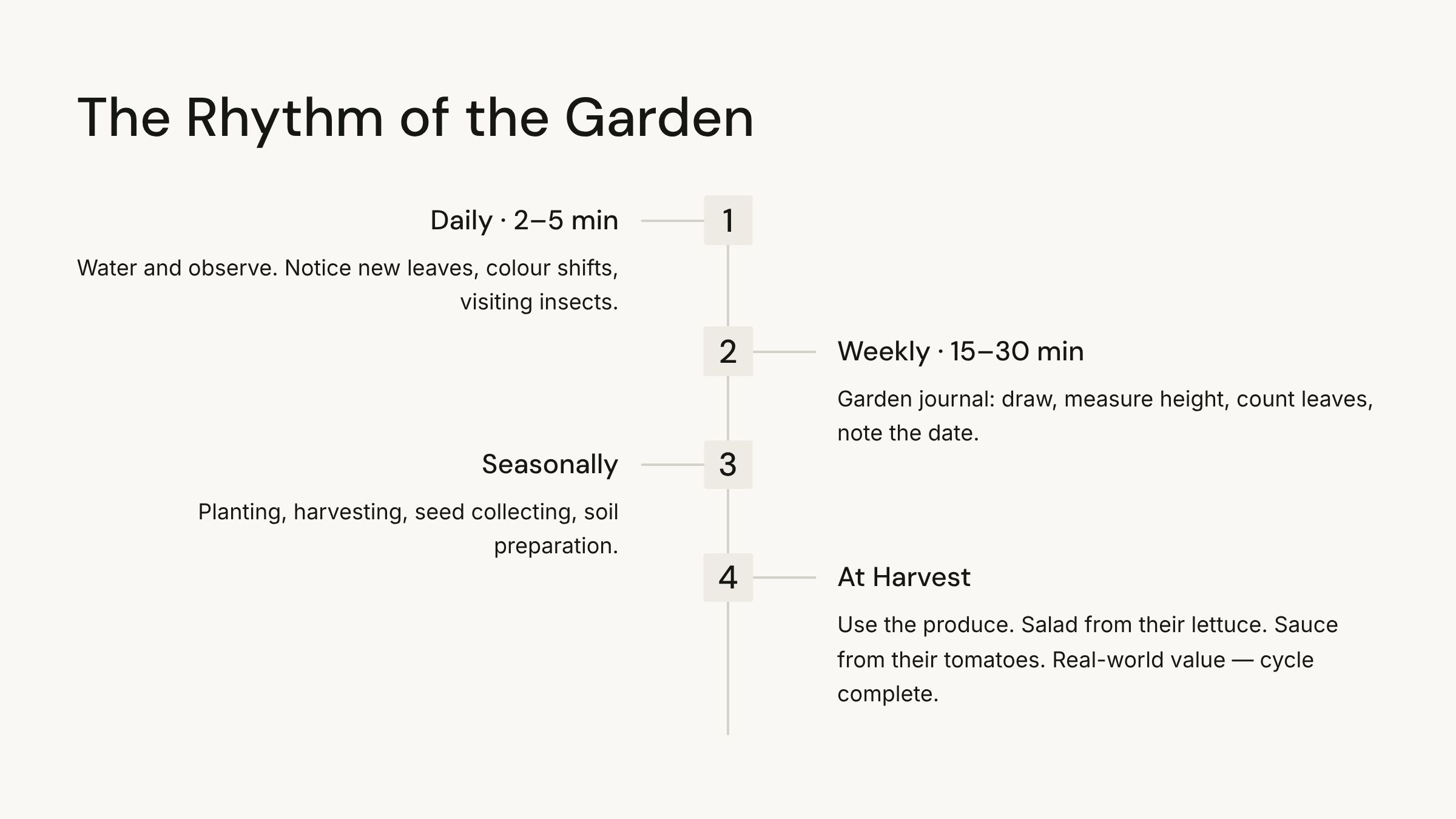
Daily (2–5 minutes): Water and observe. Your child checks their plants each morning or evening. Encourage them to notice changes—new leaves, colour shifts, height differences, visiting insects. This builds observational skills and the habit of sustained attention over time.
Weekly (15–30 minutes): Garden journal time. Your child draws or writes about what they’ve observed. Measure plant height with a ruler. Count leaves or blossoms. Note the date. Over weeks, this journal becomes a record of growth—and a personal dataset your child created themselves.
Seasonally: Planting, harvesting, seed collecting, and soil preparation. These larger events mark the turning of the year and give your child a felt sense of seasonal rhythm that indoor life alone cannot provide.
At harvest: Involve your child in using their produce. A salad made from their lettuce. A sauce from their tomatoes. A vase of their flowers on the dinner table. This reinforces the idea that their work has real-world value and completes the cycle from effort to reward.
What You’ll See Change
Parents who give their children individual garden plots consistently report a pattern of development that echoes Fröbel’s observations:
Within the first week: Frequent, unsolicited checking on plants. Your child visits their plot without being asked. They become protective of their space—this is ownership developing.
Within the first month: Increased patience and tolerance for waiting. Your child stops asking “has it grown yet?” every hour and begins to understand that growth happens on nature’s schedule, not theirs. This is a foundational life skill that transfers far beyond the garden.
Within the first season: Observable responsibility. Your child remembers to water without reminders. They notice problems (wilting, pests, weeds) and attempt solutions before asking for help. They take pride in their harvest, however small, and want to share it.
Over the first year: A changed relationship with food, nature, and their own capacity. Children who garden understand where food comes from. They notice seasons. They observe insects, soil, and weather with a new attentiveness. And they carry a quiet confidence—the knowledge that they can care for something living, and that their care makes a difference.
These changes are gradual. They’re also profound. And they happen because the garden teaches in a way no human instructor can: through natural consequences, over real time, with real stakes.
More Than Botany
Fröbel never saw the garden as a botany lesson. He saw it as the most complete educational environment available—one that engages the Head, Heart, and Hand simultaneously, always.
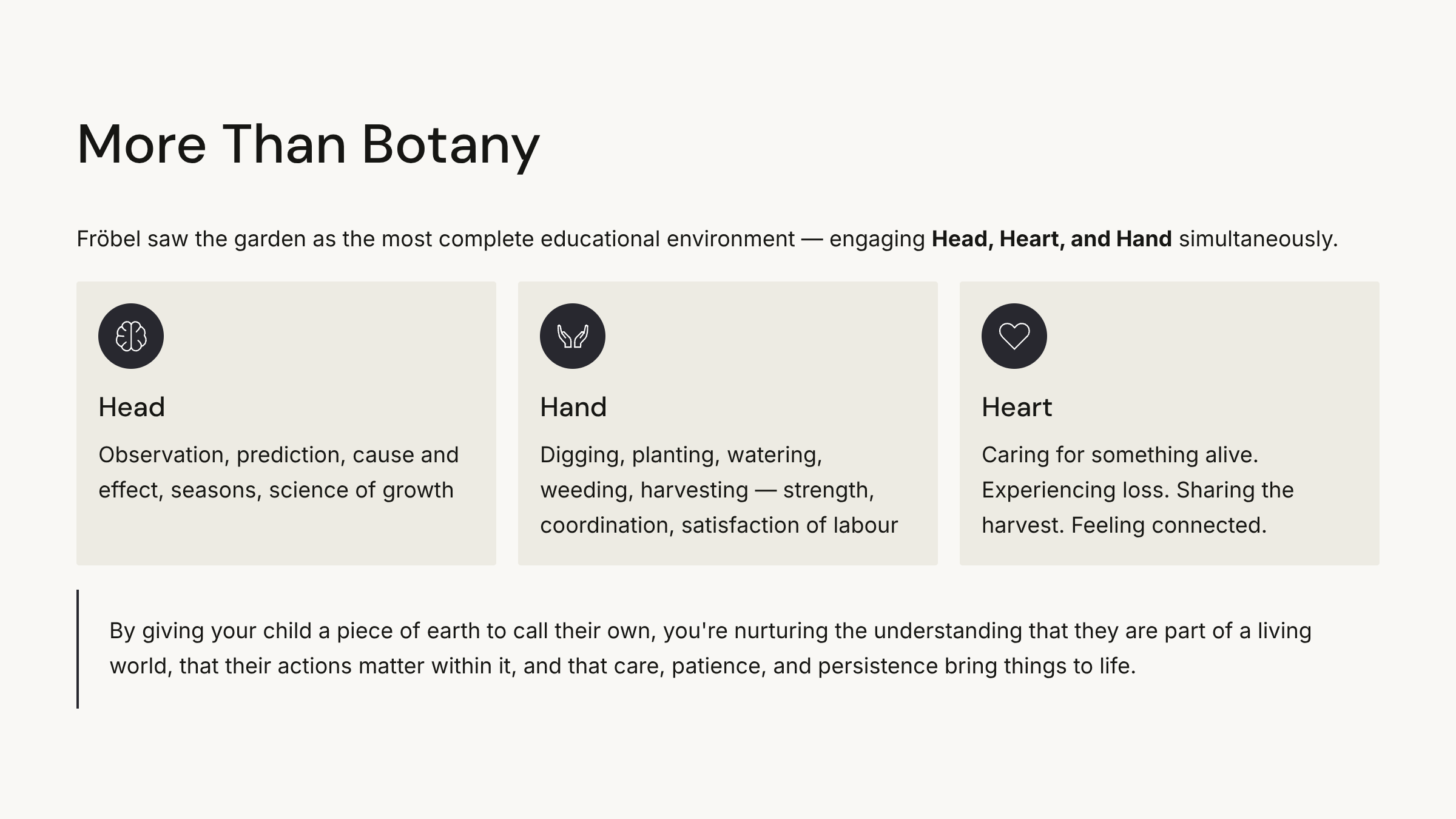
The Head: Observation, prediction, measurement, cause and effect, the cycle of seasons, the science of germination and growth.
The Hand: Digging, planting, watering, weeding, harvesting—physical work that develops strength, coordination, and the satisfaction of labour.
The Heart: Caring for something alive. Experiencing loss when a plant dies. Sharing the harvest with family. Feeling connected to the natural world. Learning that patience and persistence lead to things of genuine value.
When your child kneels in the dirt and presses a seed into the earth, they’re doing all three at once. That’s holistic education. That’s Head, Heart, and Hand. And that’s why Fröbel named his life’s work after a garden.
By giving your child a piece of earth to call their own—however small—you’re not just teaching them about plants. You’re nurturing something deeper: the understanding that they are part of a living world, that their actions matter within it, and that care, patience, and persistence bring things to life.
Fröbel called it nurturing the “divine spark” in every child. You might simply call it watching your child grow alongside their garden. Either way, it starts with a seed, a pot of soil, and three words: “This one’s yours.”
Coming Next Week
The garden teaches children to care for plant life. But Fröbel’s vision of connecting children to the living world didn’t stop at the soil.
Next week, we explore how learning responsibility through animal care continues this journey—fostering empathy, daily commitment, and a deep understanding that other living things depend on us.
If your child has ever begged for a pet, Fröbel has something important to say about why that instinct matters more than you might think.
This is part of our ongoing Fröbel Gifts Masterclass at the Spielgaben Homeschool Series. If you’re new here, start with our earlier posts on Fröbel’s life story, the Law of Opposites, and Holistic Education: Head, Heart, and Hand and The First Gift: The Ball and The Second Gift: Sphere, Cylinder, and Cube and The Divided Cubes: Gifts 3–6 and Parquetry and Patterns and Paper Folding and Cutting, and Stick and Pea Work.
Subscribe here to follow the complete Masterclass series and give your child the gift of purposeful play.




LEAVE A COMMENT