
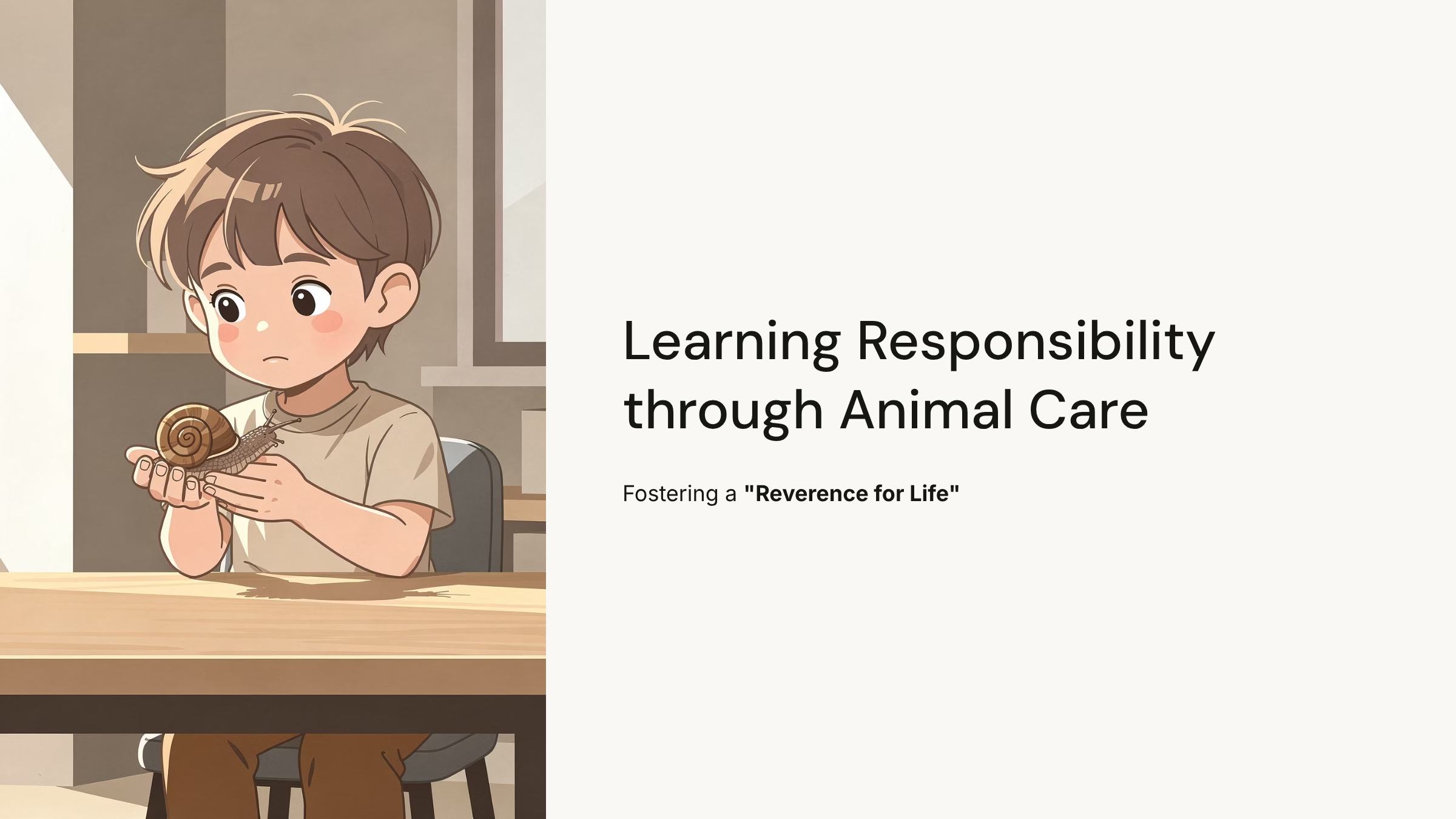
Learning Responsibility through Animal Care: Fostering a “Reverence for Life”
Your five-year-old finds a snail in the garden. She picks it up. She turns it over. She pokes its shell. She watches the body retract inside and waits—fascinated, patient—for it to re-emerge.
Your first instinct might be: “Put it down, you’ll hurt it.”
Fröbel’s instinct was different. He’d say: “She’s not trying to hurt it. She’s trying to understand it.”
That distinction—between cruelty and curiosity—changes everything about how we guide children toward the natural world. And it’s the foundation of today’s post.
In our previous article, we explored why every child needs their own garden plot to tend—how plants teach self-efficacy, patience, and the cycle of living nature. But Fröbel’s vision of connecting children to the living world didn’t stop at the soil. Plants grow and respond. But animals behave. They move. They communicate. They need things. They depend on you.
And that dependence—that daily, non-negotiable, can’t-skip-a-day dependence—is where some of the deepest lessons in a child’s education begin.
Curiosity, Not Cruelty: Understanding What Children Are Really Doing
Let’s address the uncomfortable moment first, because every parent has experienced it.
Your child pulls the legs off a beetle. Squeezes a frog too tightly. Chases a bird until it’s exhausted. Pokes a worm repeatedly with a stick.
It looks like cruelty. It feels alarming. And our instinct is to scold, to stop, to deliver a lecture about being “gentle with living things.”
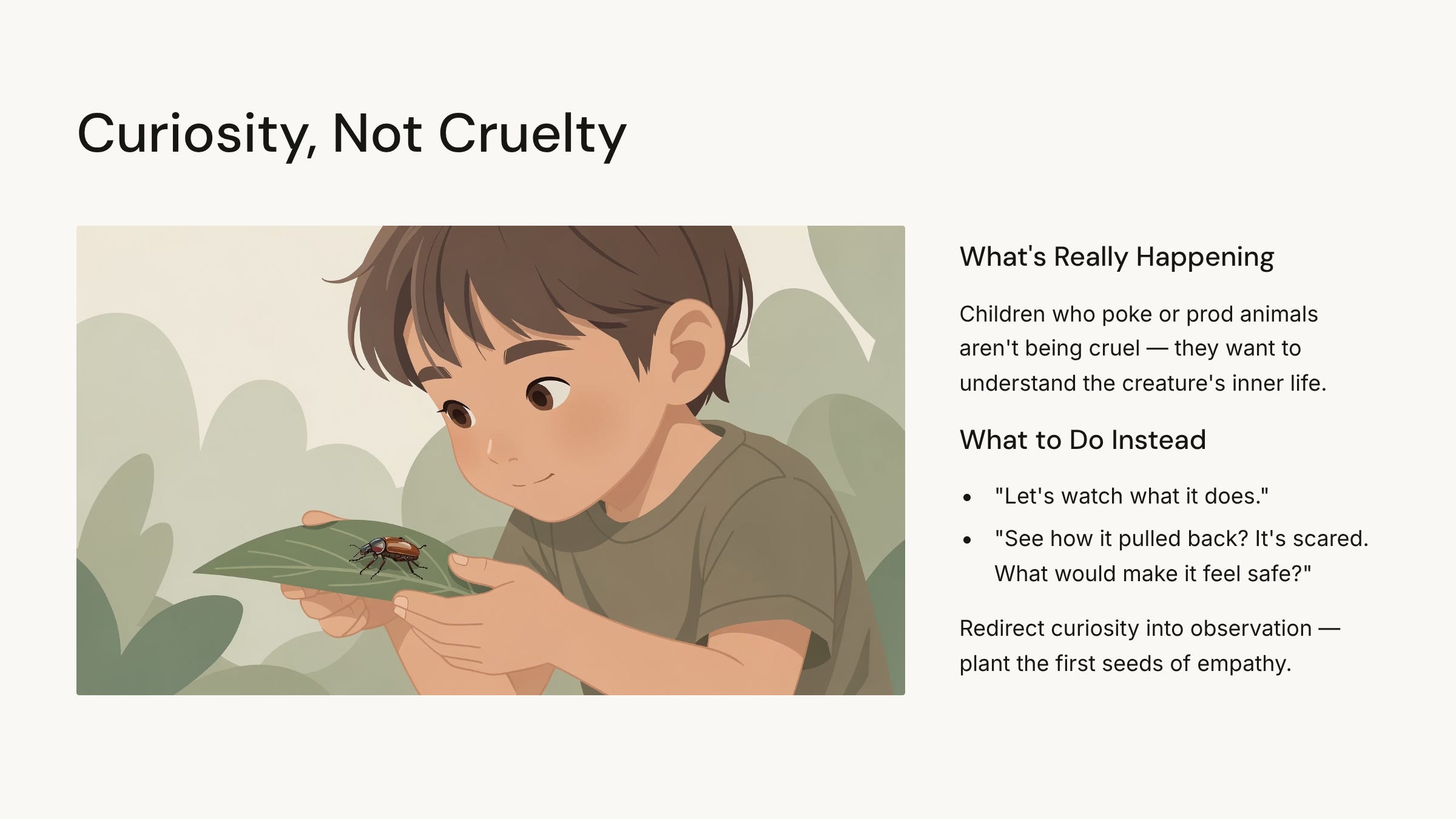
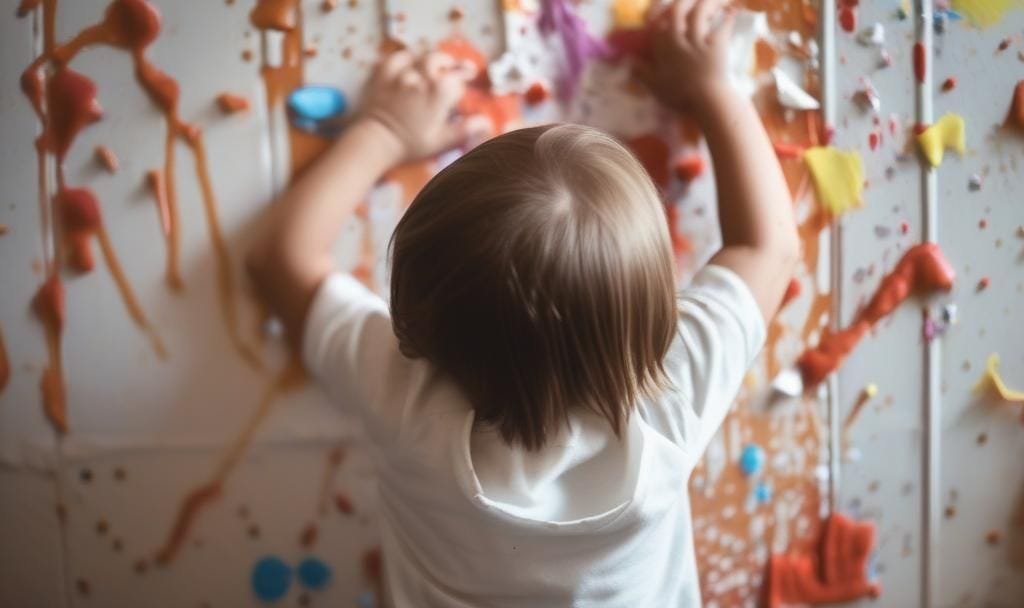
Fröbel made a startling observation about these moments: this behaviour is rarely cruelty in any meaningful sense. It is, almost always, a misdirected desire to understand the inner life of the creature. The child doesn’t want to hurt the beetle—they want to know what the beetle is. How it works. What’s inside. Why it moves the way it does.
Sound familiar? It’s the same “destructive instinct” we explored in our post on the Divided Cubes—the urge to take things apart to understand how they’re made. The difference is that a cube doesn’t suffer when you disassemble it. An animal does.
This is why guidance matters so much. If we simply punish or suppress this instinct, we miss the opportunity to redirect it. The child doesn’t learn empathy—they learn to hide their curiosity. And over time, if the instinct is never properly channelled, children can become genuinely hardened toward animal life.
But if we redirect their gaze—if we teach them to observe how an animal behaves, how it lives, how it relates to its environment—we help them discover the animal’s inner being through its complexity and behaviour, not by taking it apart.
What to do in the moment: Instead of “Don’t touch it!” try “Let’s watch what it does.” Instead of “You’re hurting it!” try “See how it pulled back inside its shell? That means it’s scared. What do you think would make it feel safe?” You’re not permitting cruelty. You’re transforming a clumsy interaction into an observation lesson—and planting the first seeds of empathy.
Why Animal Care Teaches What Nothing Else Can
Your child’s garden taught them about responsibility. But let’s be honest: if you forget to water a plant for two days during a busy week, the plant might wilt but it won’t look at you with hungry eyes.
Animals change the equation entirely. They introduce urgency, dependence, and emotional reciprocity into the care relationship. And those three elements create a learning experience that no other part of Fröbel’s system—or any curriculum—can replicate.
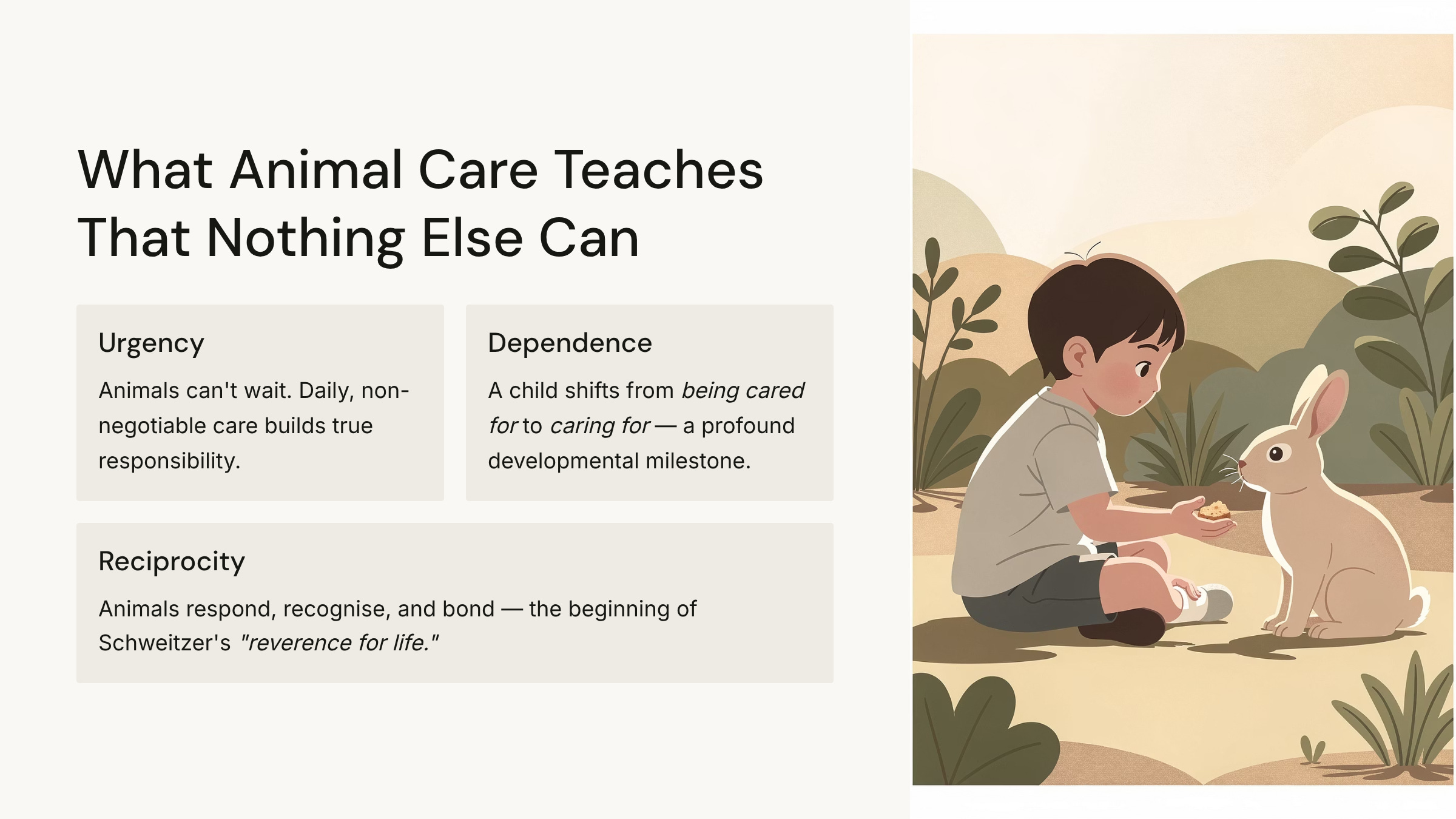
Urgency: It Can’t Wait
A garden tolerates some neglect. An animal doesn’t. The fish needs feeding today. The rabbit’s water bottle needs refilling this morning. The guinea pig’s enclosure needs cleaning this week, not next.
This non-negotiable rhythm is exactly what makes animal care such a powerful teacher of responsibility. There’s no “I’ll do it later” that doesn’t have consequences.
The creature’s wellbeing depends on your child showing up, consistently, whether they feel like it or not.
For homeschool families, this daily rhythm also creates a natural structure to the day. Morning animal care becomes a routine that grounds everything that follows—a purposeful start that has nothing to do with curriculum and everything to do with character.
Dependence: Something Needs Me
One of the most profound experiences a child can have is realising that another living being depends on them. Not wants them around. Not enjoys their company. Depends on them for survival.
This realisation shifts a child’s self-concept. They’re no longer just a recipient of care—someone who is fed, sheltered, and looked after by parents. They become a provider of care. Someone whose actions directly sustain another life.
That shift from “I am cared for” to “I care for” is one of the most important developmental milestones in childhood. And while gardening introduces it gently, animal care makes it visceral and undeniable.
Emotional Reciprocity: It Responds to Me
Water a plant and it grows—eventually, invisibly, on its own schedule. Feed a rabbit and it hops toward you. Sit quietly by a fish tank and the fish glide to the surface. Speak softly to a guinea pig and it chirps back.
Animals respond. They recognise. They form bonds. And that reciprocity creates an emotional connection that deepens your child’s investment in the care relationship far beyond what duty alone could sustain.
When your child says “the guinea pig knows me—she comes to the front of the cage when she hears my voice,” they’re not anthropomorphising. They’re recognising a relationship. And that recognition—that another living being relates to them as an individual—is the beginning of what Albert Schweitzer called “reverence for life.”
The Full Circle: Joy and Hardship
Here’s something important that well-meaning parents sometimes try to shield their children from: animal care includes sorrow.
Fish die. Snails escape and aren’t found. Rabbits get sick. Beloved guinea pigs grow old.
Fröbel didn’t shy away from this. He understood that caring for a living creature means experiencing the full circle—not just the joys of companionship but also the hardships and worries that come with looking after a dependent life.
This isn’t a reason to avoid animal care. It’s a reason to embrace it. A child who grieves for a pet fish has learned that life is valuable precisely because it’s finite. A child who nurses a sick animal and watches it recover has learned that care and persistence can make a difference even when things look bleak. A child who experiences loss and then chooses to care for another animal has learned that love is worth the risk of grief.
These aren’t lessons you can teach with words. They’re lessons that life teaches through experience. And the garden—in Fröbel’s fullest sense—is where children are safe enough to experience them.
Your role as the parent: Don’t hide these moments. Don’t replace a dead fish before your child notices. Acknowledge the loss. Let them feel it. Talk about it honestly. And when they’re ready, help them decide whether they want to take on the responsibility of caring for another life. That decision—made freely, after experiencing both the joy and the cost—is maturity forming in real time.
Practical Animal Care for Your Homeschool
You don’t need a farm. You don’t even need a pet. Fröbel’s principles can be implemented at almost any scale, from a snail found in the garden to a family dog. Here’s how to approach it at different levels of commitment.
Level 1: Observation Without Ownership (Any Age, Any Setting)
This is where every family can start, regardless of living situation, allergies, or budget.
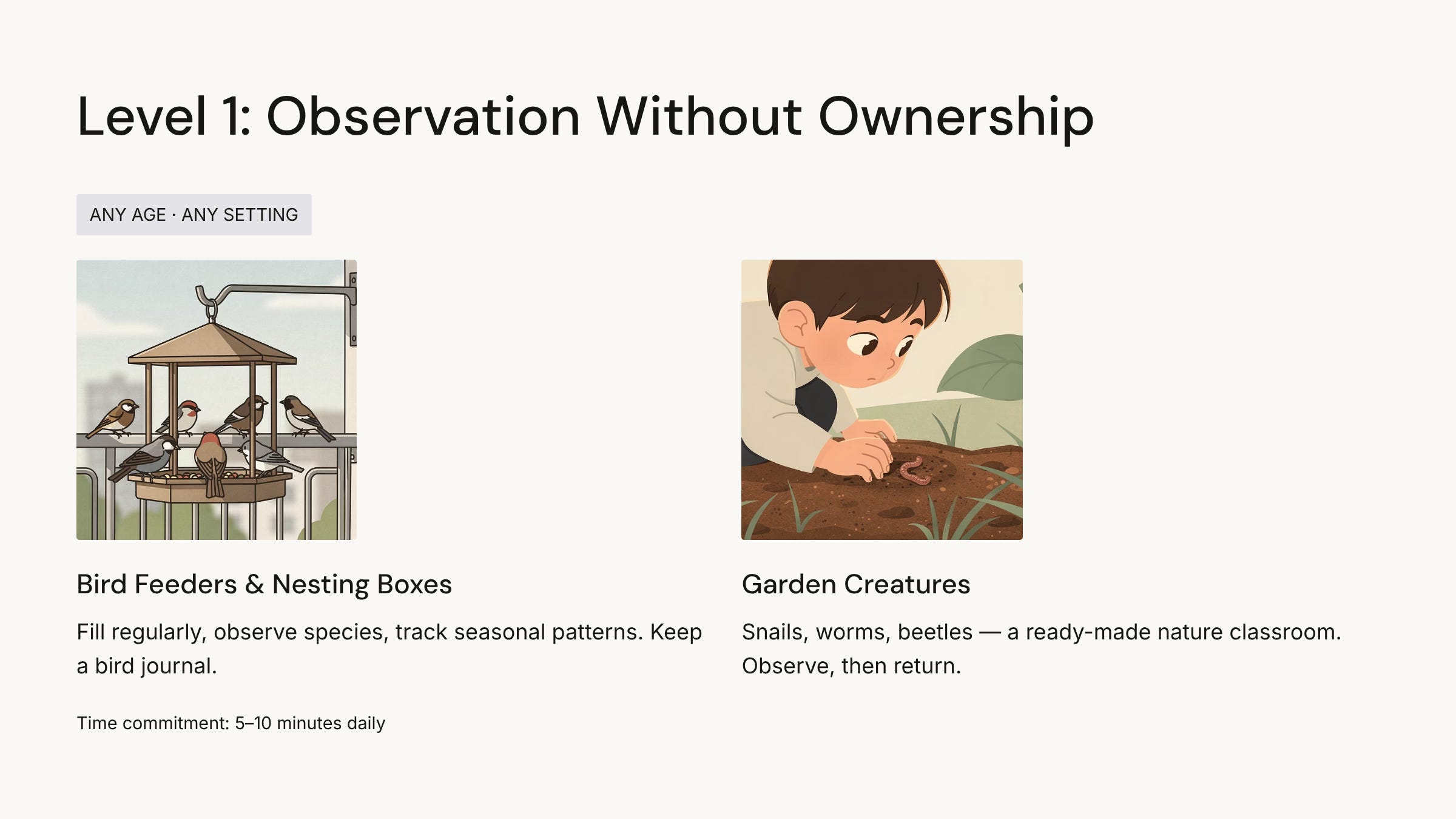
Bird feeders and nesting boxes. Fröbel himself recommended this in his Mother and Nursery Songs. Hang a bird feeder in your garden, on your balcony, or visible from a window. Your child fills it regularly—that’s the responsibility. They observe which species visit—that’s the science. They notice seasonal patterns—some birds come in winter, others in summer—that’s the nature study.
Build a simple nesting box together. Mount it in a sheltered spot. In spring, your child may witness birds choosing their box, building a nest, and raising chicks—all from a respectful distance. The lesson: you created conditions for life to flourish, and life responded.
Activities:
- Keep a bird journal: date, species, behaviour observed. This builds observation skills and creates a personal nature record.
- Research which birds are native to your area and what food they prefer. Your child becomes the “expert” on their local birdlife.
- Count birds during a set observation window each week. This introduces simple data collection.
Garden creatures. The snails, worms, beetles, and spiders in your garden are a ready-made nature classroom. Rather than “don’t touch,” try “let’s learn about it.” Set up a temporary observation station—a clear container with some soil and leaves—where your child can watch a creature for an afternoon before returning it to where they found it.
Time commitment: 5–10 minutes daily for feeder maintenance and observation. Occasional longer sessions for journaling or research.
Level 2: Contained Ecosystems (Ages 4+)
This is the step between observation and full pet ownership. It introduces daily care responsibility with relatively low stakes.
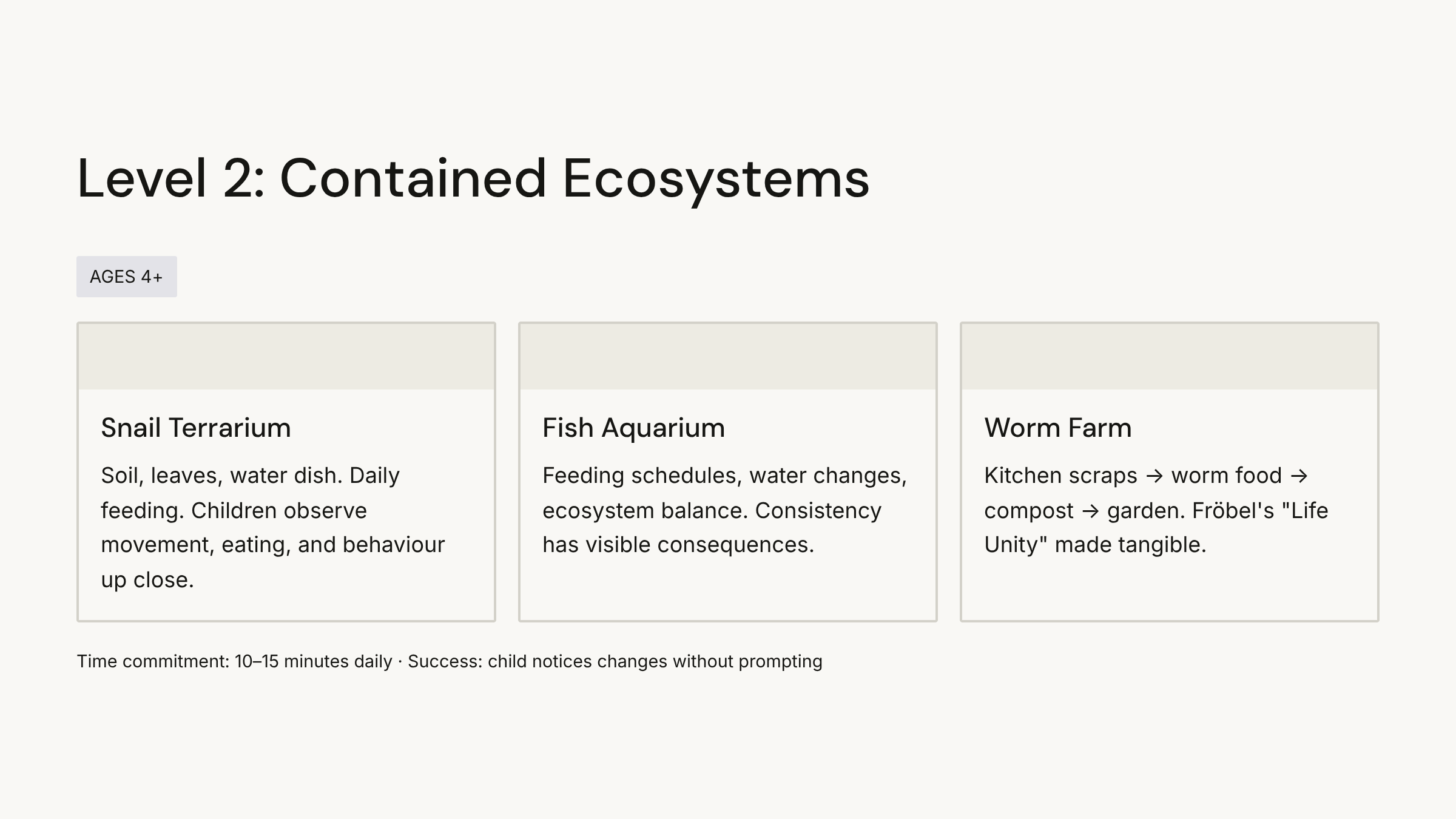
Snail terrarium. Garden snails are among the easiest creatures to care for and one of the most fascinating to observe. A clear container with ventilation, some soil, leaves, and a shallow water dish creates a simple habitat. Your child feeds the snails daily (lettuce, cucumber, carrot) and mists the enclosure to maintain humidity.
What children notice: how snails move, how they eat (the rasping sound of the radula is genuinely astonishing to children), how they retract when startled, how they leave trails. This is animal behaviour study at its most accessible.
Fish aquarium. A small freshwater aquarium introduces a more complex care routine: feeding on schedule, monitoring water clarity, partial water changes. Start simple—a betta fish or a few guppies in a properly cycled tank.
What children learn: that different species have different needs (water temperature, food type, social requirements). That an ecosystem must be maintained—the balance of the tank mirrors the balance of the natural world. That consistency matters—skipping a feeding or neglecting a water change has visible consequences.
Worm farm. A worm composting bin connects animal care directly back to the garden. Your child feeds kitchen scraps to the worms, observes decomposition, and harvests castings to fertilise their garden plot. The cycle from food waste to worm food to compost to plant growth to harvest is “Life Unity” made tangible.
Time commitment: 10–15 minutes daily for feeding and basic maintenance. Weekly longer sessions for cleaning, water changes, or habitat adjustments.
What success looks like: Your child remembers feeding without reminders. They notice changes in their creatures’ behaviour (”the snails are more active when it rains”). They show concern when something seems wrong and attempt solutions before asking for help.
Level 3: Small Mammals and Deeper Commitment (Ages 5+)
This is where animal care becomes a genuine daily commitment—and where the deepest lessons in responsibility emerge.
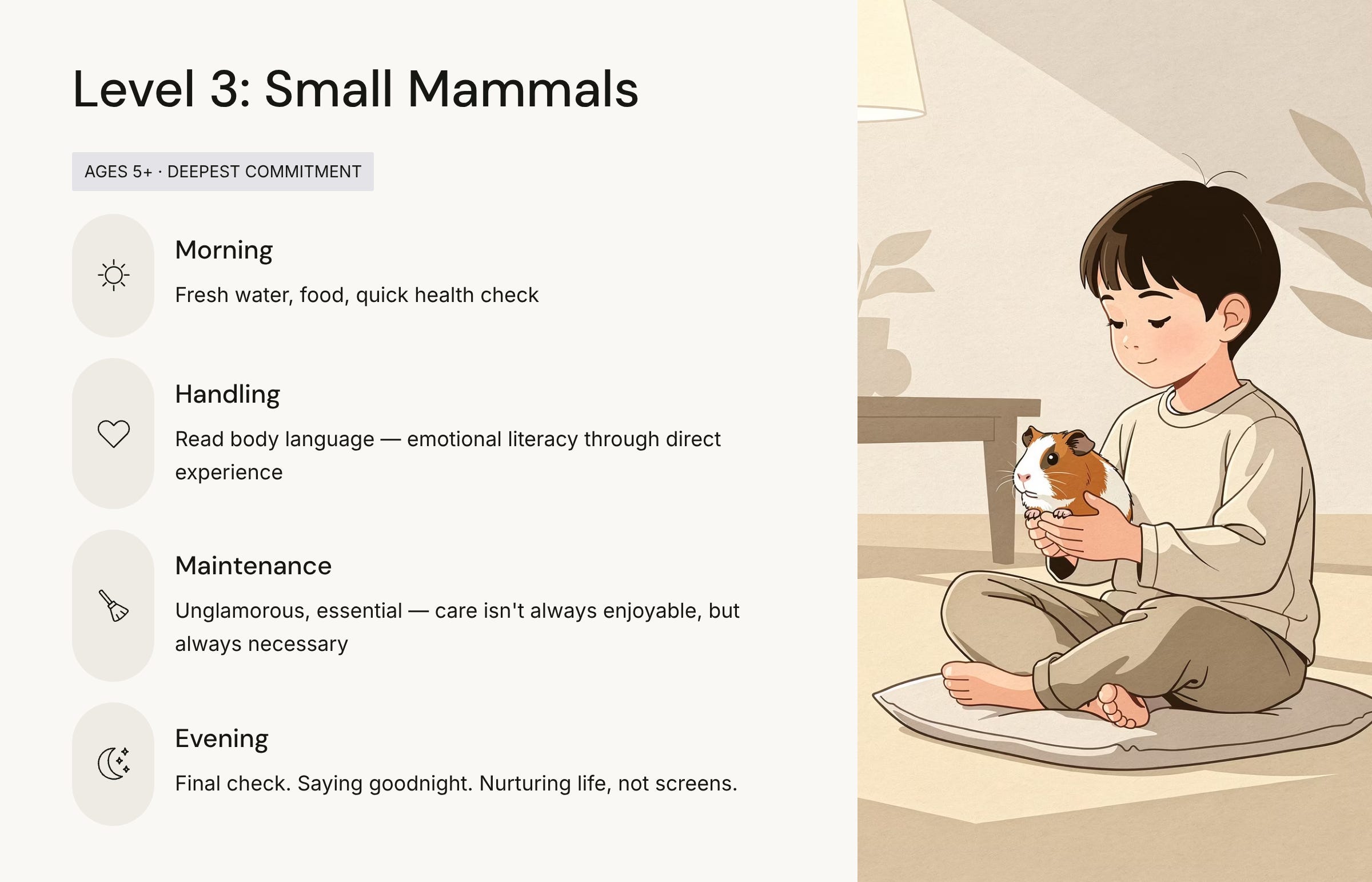
Guinea pigs. These are perhaps the ideal first mammal for a Fröbelian homeschool. They’re social (keep at least two), vocal (children love their range of sounds), gentle enough for young handlers, and have clear care needs that create a structured routine.
Rabbits. Slightly more complex in their needs but deeply rewarding. Rabbits can be litter-trained, respond to their names, and form strong bonds with their caregivers. They require daily handling, fresh hay and vegetables, and regular enclosure cleaning.
Daily rhythms your child participates in:
- Morning: Fresh water and food. A quick health check—are the animals moving normally? Eating? Alert? This teaches observation as a care skill.
- Handling time: Gentle, supervised interaction. Your child learns to read the animal’s body language—when it’s relaxed, when it’s anxious, when it wants to be put down. This is emotional literacy developing through direct experience.
- Enclosure maintenance: Spot-cleaning daily, full cleaning weekly. This is unglamorous, essential, and teaches the lesson that care isn’t always enjoyable—but it’s always necessary.
- Evening: Final food and water check. Saying goodnight. This creates a bookend to the day that has nothing to do with screens or homework and everything to do with nurturing life.
Time commitment: 20–30 minutes daily for feeding, handling, and basic maintenance. One longer session (45–60 minutes) weekly for thorough cleaning.
What success looks like: Your child anticipates the animal’s needs before being reminded. They notice subtle changes in behaviour or appetite and raise concerns. They accept unglamorous tasks (cleaning, hay-changing) as a non-negotiable part of the relationship. They speak about their animal with genuine affection and knowledge.
For All Levels: The Fröbelian Framework
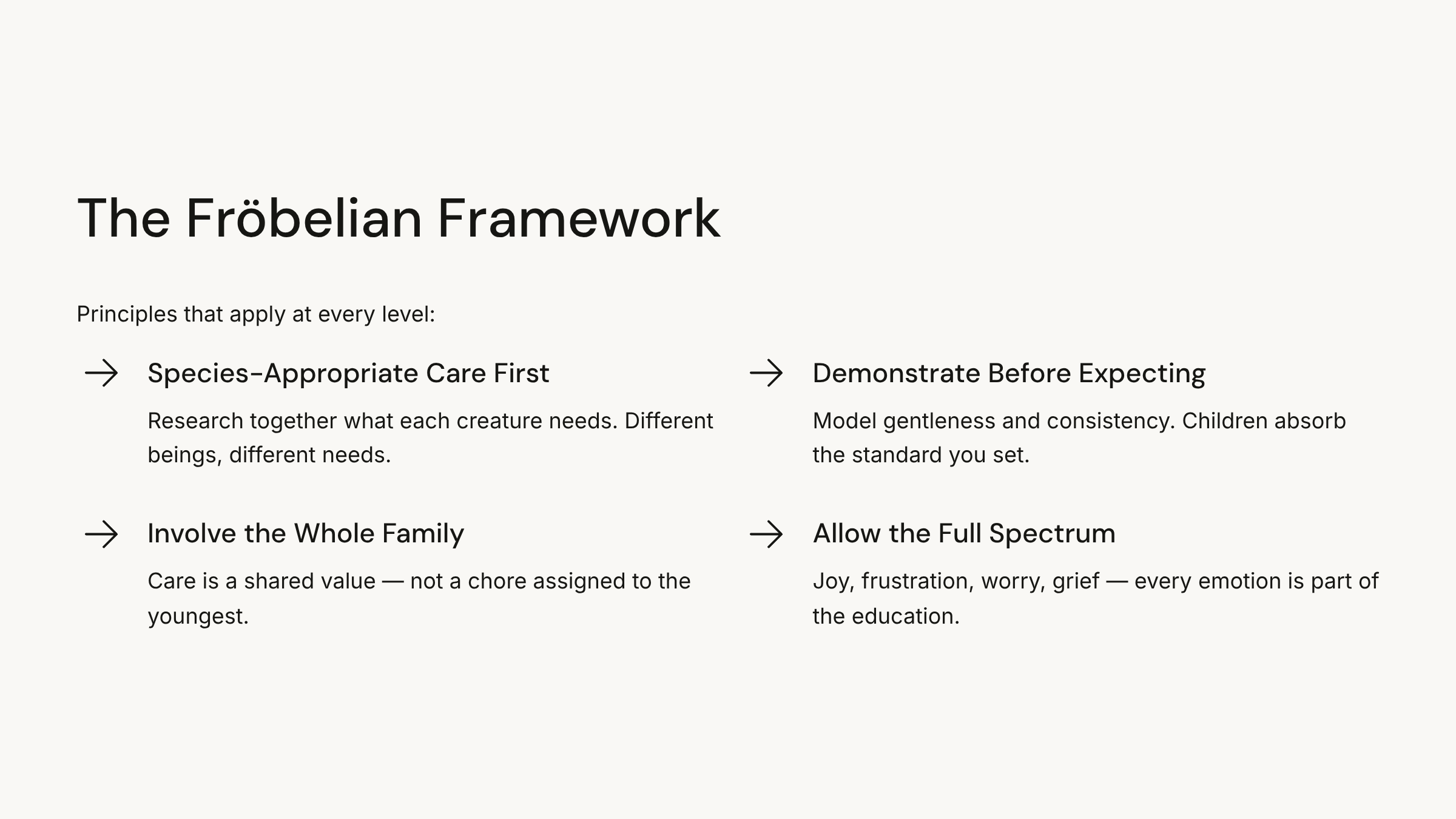
Regardless of which level you implement, these principles apply:
Species-appropriate care comes first. Before your child begins caring for any creature, research together what that specific animal needs to thrive. This isn’t just responsible pet ownership—it’s Fröbel’s “Forms of Knowledge” applied to animal life. Your child learns that different beings have different needs, and that good care means understanding those needs, not imposing your own preferences.
Demonstrate before expecting. Just as Fröbel recommended a “demonstration bed” in the garden, model animal care before handing responsibility to your child. Let them watch you feed, clean, and handle the animals with gentleness and consistency. They’ll absorb the standard you set.
Involve the whole family. In Fröbel’s kindergarten in Weimar, parents and children shared animal care responsibilities, especially on weekends. This shouldn’t be your child’s burden alone. It should be a family practice that strengthens the partnership between parent and child—and shows your child that care is a shared value, not a chore assigned to the youngest member.
Let them experience the full spectrum. Joy when the animal responds to them. Frustration when it won’t cooperate. Worry when it seems unwell. Grief when it dies. Every emotion is part of the education. Don’t curate the experience into pure delight—real care includes real difficulty, and children are stronger for having navigated it.
The Deeper Lesson: From Caring for Others to Caring for Yourself
Fröbel’s ultimate purpose in introducing animal care wasn’t to produce good pet owners—though that’s a worthy outcome. It was something larger.
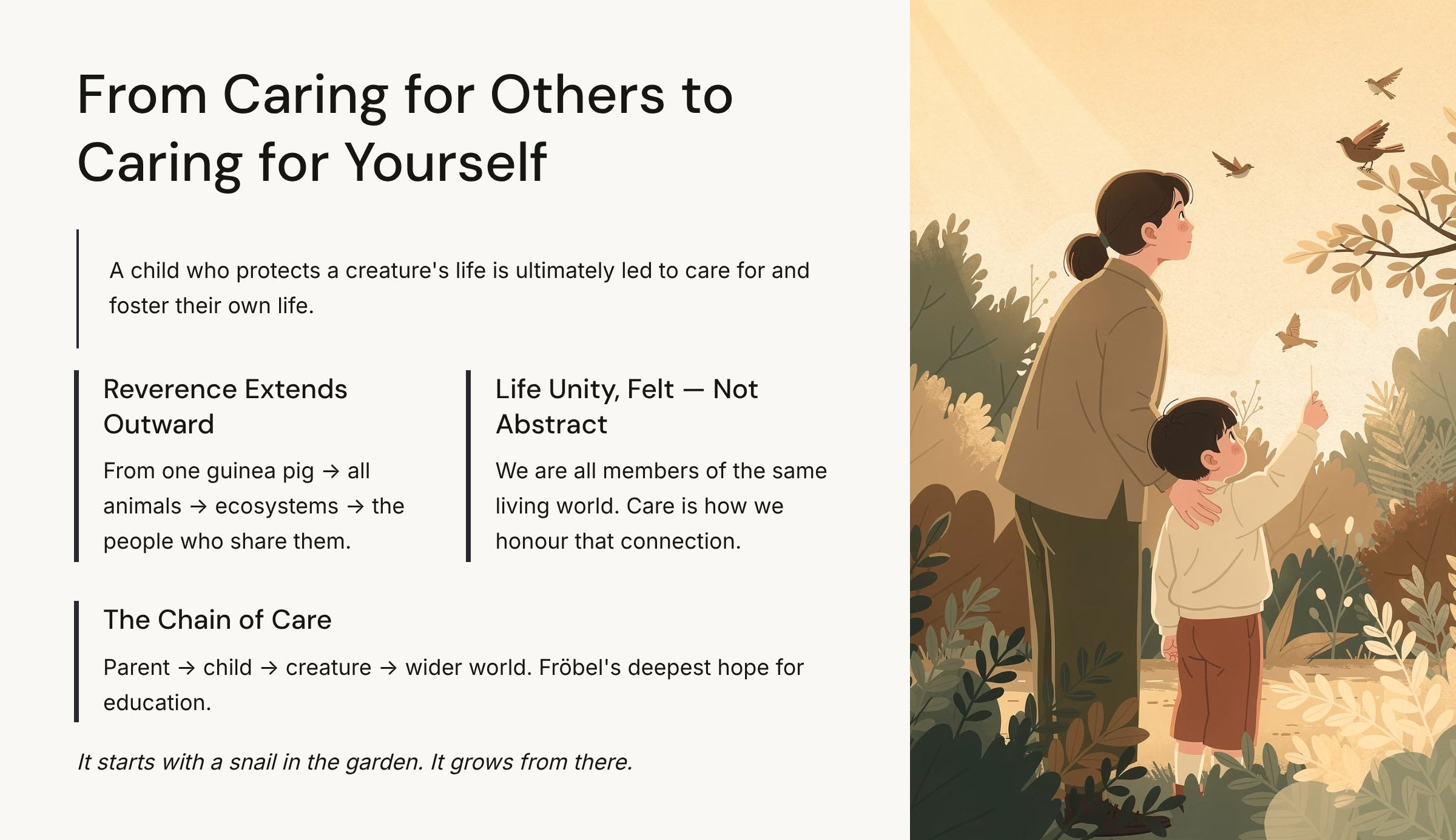
He believed that through protecting the life of a creature, a child is ultimately led to care for and foster their own life. The reverence they develop for another being’s needs, vulnerabilities, and inherent value gradually extends inward. A child who understands that a guinea pig needs clean water, proper food, and gentle handling begins to understand—intuitively, without lectures—that they deserve those same things.
And the reverence extends outward, too. From one guinea pig to all guinea pigs. From guinea pigs to rabbits to birds to insects. From the creatures in their care to the creatures in the wild. From animals to the ecosystem that sustains them. From the ecosystem to the people who share it.
Fröbel’s “Life Unity” isn’t an abstract concept when a child has held a living, breathing creature that depends on them. It’s a felt truth: we are all members of the same living world. We all depend on each other. And care—real, daily, unglamorous care—is how we honour that connection.
When a child experiences love and care from an adult toward an animal, they develop a natural need to pass that love and care on. That chain of care—from parent to child to creature to the wider world—is Fröbel’s deepest hope for education.
It starts with a snail in the garden. It grows from there.
Coming Next Week
We’ve journeyed through the indoor world of Gifts and Occupations. We’ve stepped outside into the garden. We’ve explored the living world through plants and animals.
In our next and final article in this series, we bring everything full circle with Movement Games and Community—exploring how Fröbel used group play to build social health, physical joy, and the understanding that we are, each of us, members of a larger whole.
It’s the perfect ending to a journey that began with a single ball in a child’s hands.
This is part of our ongoing Fröbel Gifts Masterclass at the Spielgaben Homeschool Series. If you’re new here, start with our earlier posts on Fröbel’s life story, the Law of Opposites, and Holistic Education: Head, Heart, and Hand and The First Gift: The Ball and The Second Gift: Sphere, Cylinder, and Cube and The Divided Cubes: Gifts 3–6 and Parquetry and Patterns and Paper Folding and Cutting, and Stick and Pea Work and The Children’s Garden.
Subscribe here to follow the complete Masterclass series and give your child the gift of purposeful play.






LEAVE A COMMENT